


Immune Thrombocytopenia (ITP): Causes, Symptoms & Ayurvedic Support
Abstract
Immune thrombocytopenia (ITP) is an acquired autoimmune hematological disorder characterized by increased platelet destruction, impaired platelet production, and decreased circulating platelet count leading to bleeding manifestations of variable severity. The condition may present as primary ITP or develop secondary to infections, autoimmune disorders, medications, and other systemic factors. In Ayurveda, ITP does not have an exact classical disease counterpart, but its pathology can be interpreted through the involvement of Agni (digestive and metabolic function), Rakta Dhatu (blood tissue), Pitta Dosha (metabolic and inflammatory regulatory principle), Vata Dosha (regulatory principle governing movement), and Rakta Vaha Srotas (channels responsible for blood circulation). Disturbance of Agni may impair proper tissue nourishment and contribute to Ama (undigested toxic metabolic waste) formation, while Pitta has a close functional relationship with Rakta and influences bleeding manifestations. Vata affects the normal movement of Rakta, while impairment of Rakta Vaha Srotas contributes to disturbed tissue function.
INTRODUCTION
Immune Thrombocytopenia (ITP) – Formerly Known as Idiopathic Thrombocytopenic Purpura
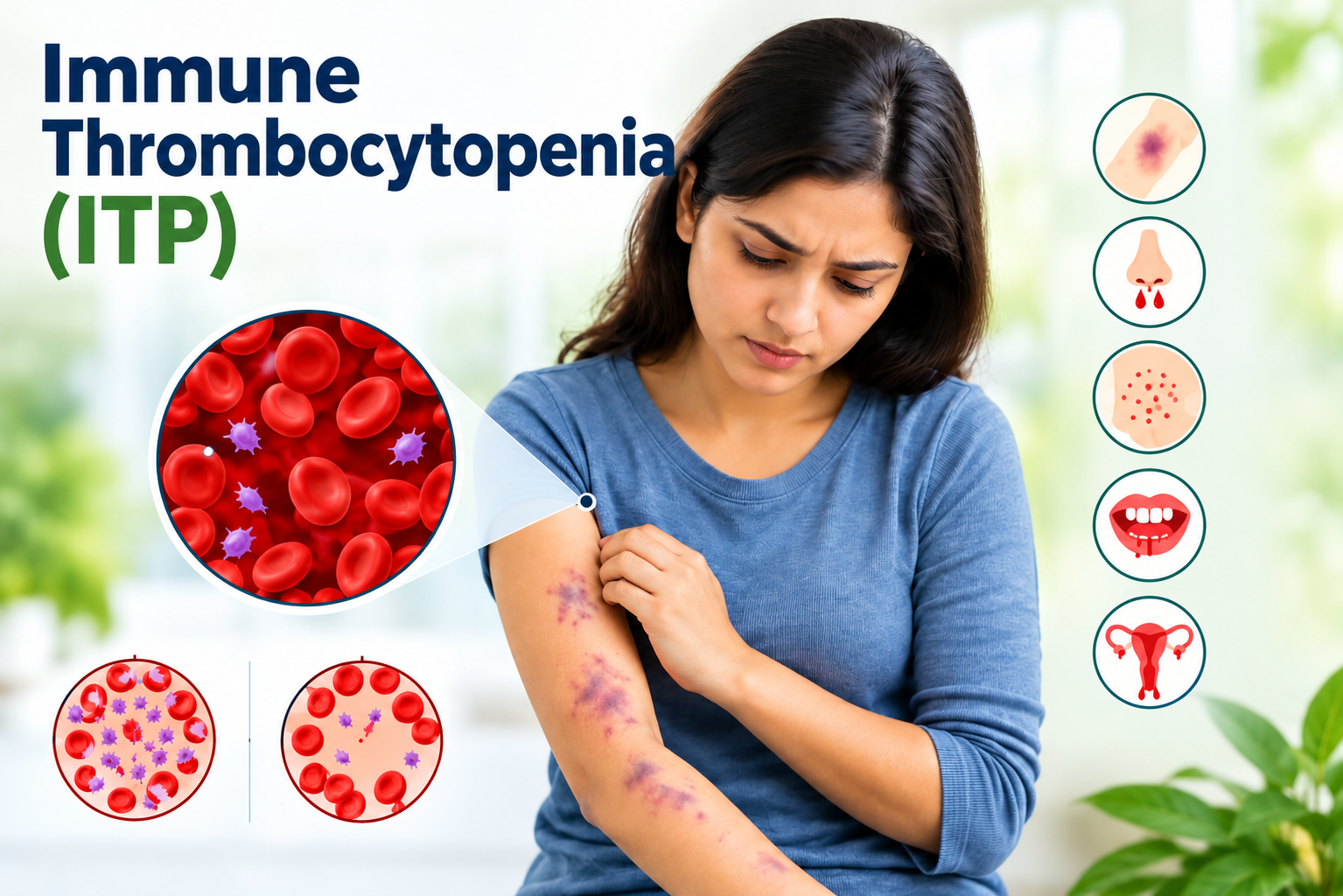
Immune thrombocytopenia (ITP) is an acquired autoimmune blood disorder characterized by a reduced platelet count resulting from immune-mediated platelet destruction and impaired platelet production. Because platelets are essential for hemostasis, their deficiency leads to petechiae, purpura, easy bruising, and mucosal bleeding.
Causes of Immune Thrombocytopenia (ITP)
- Autoimmune dysfunction: Autoantibodies mistakenly target platelet membrane glycoproteins for destruction.
- Viral infections: Triggering infections include HIV, hepatitis C, and hepatitis B.
- Bacterial infections: Helicobacter pylori infection is associated with immune-mediated platelet loss in subset populations.
- Autoimmune diseases: Systemic lupus erythematosus (SLE) and antiphospholipid syndrome can precipitate secondary ITP.
- Medications: Drug-induced thrombocytopenia can result from specific pharmaceutical immune reactions.
- Lymphoproliferative disorders: Conditions affecting lymphocytes disrupt normal immune tolerance.
- Pregnancy: Physiological and immunological shifts can trigger or exacerbate secondary thrombocytopenia.
- Primary (Idiopathic) ITP: Occurs without an identifiable underlying cause or secondary disease.
Pathogenesis of ITP
ITP stems from a breakdown in self-tolerance leading to anti-platelet autoantibody production (primarily IgG against GPIIb/IIIa or GPIb/IX complexes). Macrophages in the spleen and liver clear these antibody-coated platelets via Fcγ receptors. Concurrently, autoantibodies and T-cell-mediated cytotoxicity target megakaryocytes in the bone marrow, suppressing thrombopoiesis.
Standard Duration Classification of ITP
In accordance with international consensus guidelines, ITP is classified by duration as follows:
- Newly diagnosed ITP: Duration of less than 3 months.
- Persistent ITP: Duration of 3 to 12 months (includes patients not reaching spontaneous remission or not maintaining response off therapy).
- Chronic ITP: Duration of more than 12 months.
(Note: While pediatric cases frequently experience spontaneous resolution within 3 months, adult cases more commonly transition to chronic status.)
SIGNS AND SYMPTOMS OF ITP
- Petechiae: Pinpoint red or purple spots, commonly appearing on dependent extremities.
- Purpura: Confluent areas of cutaneous bleeding.
- Ecchymosis: Easy or excessive bruising following minimal trauma.
- Mucosal bleeding: Recurrent epistaxis (nosebleeds) and gingival (gum) bleeding.
- Menorrhagia: Abnormally heavy or prolonged menstrual bleeding.
- Gastrointestinal / Genitourinary bleeding: Hematuria, hematochezia, or melena in severe cases.
- Fatigue: Frequently reported independent of or secondary to anemia.
- Intracranial Hemorrhage: A rare but life-threatening complication requiring immediate emergency medical intervention.
DIAGNOSIS OF ITP
- Complete Blood Count (CBC): Reveals isolated thrombocytopenia (platelet count $< 100,000/\mu\text{L}$) with normal white blood cell and red blood cell parameters.
- Peripheral Blood Smear: Excludes pseudothrombocytopenia (platelet clumping), microangiopathic hemolysis, and dysplastic cells
- Medical History & Physical Examination: Evaluates medication history, bleeding patterns, and systemic symptoms.
- Infectious Serology: Mandatory screening for HIV, HCV, and H. pylori.
- Autoimmune Panel: ANA and secondary autoimmune markers when clinical features suggest underlying systemic conditions.
- Bone Marrow Examination: Reserved for patients $> 60$ years of age, those with atypical features, or before surgical interventions like splenectomy.
CONVENTIONAL MEDICAL MANAGEMENT OF ITP
- First-line Therapy: High-dose Corticosteroids (Prednisone, Dexamethasone) and Intravenous Immunoglobulin (IVIG) or Anti-D for rapid platelet elevation.
- Second-line Therapy: Thrombopoietin Receptor Agonists (TPO-RAs: Eltrombopag, Romiplostim, Avatrombopag), Rituximab (anti-CD20 monoclonal antibody), and Fostamatinib (Syk inhibitor).
- Surgical Interventions: Splenectomy for refractory chronic cases.
AYURVEDA’s INSIGHT
ITP does not have a direct equivalent in classical Ayurvedic texts; however, it can be functionally and symptomatically correlated with Raktapitta (bleeding disorders). This correlation is strictly functional based on shared clinical manifestations such as Tiryak or Adhoga/Urdhvaga Raktapitta symptoms (epistaxis, gingival bleeding, purpura). From an Ayurvedic pathophysiological stance:
- Pitta Dosha and Rakta Dhatu: Pitta shares an Asraya-Asrayi (inherent functional) relationship with Rakta Dhatu. Pitta aggravation alters the thermal and physiological properties of blood tissue, manifesting as Rakta-Pitta symptoms.
- Rakta Vaha Srotas Dushti: Dysfunction of the microvascular and hemopoietic pathways (Srotas) leads to impaired Dhatu management.
- Agni and Ama: Impaired Jatharagni (digestive fire) and Dhatvagni (tissue metabolism) result in Ama (immature metabolic products) formation, which disrupts immune self-tolerance (Ojas).
Raktapitta serves as a practical diagnostic framework for symptomatic and supportive care rather than an exact pathogenetical match for autoimmune platelet destruction.
HERBAL REMEDIES FOR ITP BY PLANET AYURVEDA!
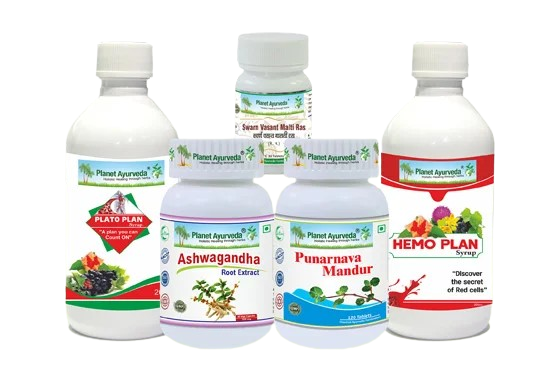
Planet Ayurveda is an Ayurveda-focused organization dedicated to promoting traditional Ayurvedic knowledge through carefully developed herbal products, educational resources, and professional consultations. Based in India, the organization offers a wide range of Ayurvedic formulations prepared according to established principles and quality practices. Planet Ayurveda works to make Ayurveda accessible to people worldwide while maintaining attention to ingredient quality, manufacturing standards, and traditional formulations. Its portfolio covers products for general wellness, personal care, nutrition, and lifestyle support. For managing ITP there are lots of formulations, out of which some are listed below:-
Herbal Remedies for Immune Thrombocytopenia (ITP)

Product description
1. Plato Plan Syrup
Platoplan capsules by planet Ayurveda is prepared using Carica papaya (Erand Karkati), Tinospora cordifolia (Giloy), Triticum aestivum (Wheat Grass), Withania somnifera (Ashwagandha), Emblica officinalis (Amalaki), Moringa pterygosperma (Shigru), Leptadenia reticulata (Jeevanti), and Vitis vinifera (Draksha). It is Used as supportive care to promote tissue vitality (Rakta Dhatu support) and overall nutritional status. Tinospora cordifolia and Emblica officinalis traditionally support Rasayana (rejuvenative) functions and systemic resilience.
Dosage: Take 5 mL to 10 mL (1 to 2 teaspoons) twice daily after meals
2. Ashwagandha Capsules
These capsules are prepared using Standardized extract of Ashwagandha (Withania somnifera). They are evaluated traditionally for its Bala (strength-promoting), Dhatu Poshan (tissue-nourishing), and Tridosha-balancing (specifically Vata-Kapha pacifying) properties. Preclinical studies suggest Withania somnifera possesses adaptogenic, antioxidant, and immunomodulatory properties that may help support physiological resilience under stress.
Dosage: Take 1 capsule twice daily with plain water after meals.
3. Punarnava Mandur
These classical tablets are prepared using Boerhavia diffusa (Punarnava), Zingiber officinale (Shunti), Piper longum (Pippali), Piper nigrum (Maricha), Emblica officinalis (Amalaki), Terminalia chebula (Haritaki), Piper chaba (Chavya), Curcuma longa (Haridra), Embelia ribes (Vidanga), Plumbago zeylanica (Chitrak Mool), and Mandoor Bhasma (processed ferric oxide calx). They acts as supportive nutritional care when secondary iron deficiency or general asthenia is present. Mandoor Bhasma traditionally supports hemoglobin synthesis, while digestive spices (Deepana/Pachana) optimize Agni.
Dosage: Take 1 to 2 tablets twice daily or three times daily with lukewarm water after meals.
4. Hemo Plan Syrup
Planet Ayurveda’s Hemoplan Syrup is prepared using Rubia cordifolia (Manjistha), Asparagus racemosus (Shatavari), Sphaeranthus indicus (Gorakhmundi), Withania somnifera (Ashwagandha), Vitis vinifera (Draksha), and Hemidesmus indicus (Sariva). It provides supportive care aimed at Pitta normalization and Rakta Dhatu balance. Manjistha and Sariva are traditionally classified as Raktashodhaka (blood-clearing) herbs.
Dosage: Take 5 mL to 10 mL (1 to 2 teaspoons) twice daily after meals.
5. Swarna Vasant Malti Ras
This classical Formulation is prepared using Swarna Bhasma (purified gold calx), Mukta Bhasma (purified pearl calx), Shuddha Hingula (purified cinnabar / mercuric sulfide), Shuddha Parad (purified elemental mercury), Shuddha Gandhak (purified sulfur), Kharpara (zinc ore calx), and Piper nigrum (Maricha). A traditional herbo-mineral formulation classified as a potent Rasayana for severe debility. In ITP, Swarna Bhasma is traditionally used for Rasayana (rejuvenative) and Balya (strength-promoting) support, while Mukta Bhasma is valued for Pitta balance (metabolic and inflammatory regulation) and Rakta dhatu(blood tissues) support. Kali Maricha (Piper nigrum) supports Agni (digestive and metabolic function) and may improve bioavailability of co-administered substances. The herbo-mineral components are traditionally used for restorative and systemic support.
Dosage: Take 1 tablet once or twice daily under professional guidance only, traditionally administered with honey, butter, or Pippali powder.
DIET AND LIFESTYLE CONSIDERATIONS IN ITP
Dietary Recommendations
- Ayurvedic Context on Amla (Sour/Citrus) Foods: Classical Ayurvedic principles recommend limiting excessively Amla (sour), Lavana (salty), and Katu (pungent) tastes in Raktapitta management because these properties irritate Pitta Dosha and vitiate Rakta Dhatu. From a modern dietary perspective, standard citrus fruits do not worsen ITP unless gastrointestinal mucosal irritation is present; however, avoiding extreme dietary irritants is reasonable for overall gastrointestinal comfort.
- Supportive Foods: Prefer warm, fresh, light, and easily digestible foods (Laghu Ahara) to maintain optimal Agni.
- Hydration: Ensure adequate daily fluid intake.
- Alcohol: Avoid alcohol completely, as ethanol can directly cause bone marrow suppression and impair platelet function.
Lifestyle Adaptations
- Trauma Prevention: Avoid contact sports and heavy high-impact exercise during periods of severe thrombocytopenia.
- Oral Hygiene: Use soft-bristled toothbrushes to prevent mucosal trauma and gingival bleeding.
- Medication Safety: Avoid over-the-counter NSAIDs (e.g., ibuprofen, naproxen) and aspirin, as they impair platelet aggregation and increase bleeding risks.
- Rest & Stress Management: Ensure adequate restorative sleep and low-impact movement to reduce systemic physiological stress.
CONCLUSION
At last we can say that Immune Thrombocytopenia (ITP) is a complex autoimmune disorder requiring vigilant clinical oversight, regular platelet monitoring, and evidence-based hematological care. While Ayurveda does not offer an exact direct equivalent to ITP, concepts of Agni, Pitta, Rakta Dhatu, and Srotas allow for individualised, supportive regimens. Ayurvedic products and dietary adjustments should strictly serve as adjunctive care to optimize general tissue health and metabolic balance under the supervision of qualified healthcare professionals.


Dr. Vikram Chauhan
Latest posts by Dr. Vikram Chauhan (see all)
- Immune Thrombocytopenia (ITP): Causes, Symptoms & Ayurvedic Support - September 18, 2026
- Ulcerative Colitis: Causes, Symptoms & Treatment with Ayurveda - September 17, 2026
- Holistic PCOD Management: Modern Science Meets Ayurvedic Healing - September 16, 2026
- Fatty Liver: Diet & Ayurvedic Management - September 15, 2026
- Fatty Liver: Causes, Symptoms & Ayurvedic Management - September 14, 2026