


Sarcoidosis: Causes, Symptoms & Ayurvedic Management
ABSTRACT
Sarcoidosis is a multisystem inflammatory disorder characterized by the formation of non-caseating granulomas, most frequently affecting the lungs and intrathoracic lymph nodes. Its clinical presentation varies widely, ranging from asymptomatic disease to significant pulmonary, ocular, cardiac, neurological, or hepatic involvement. Diagnosis requires a combination of clinical evaluation, imaging, laboratory investigations, and, when indicated, tissue biopsy, while excluding infections and other granulomatous disorders. Management depends on disease severity and organ involvement and may include observation, corticosteroids, immunosuppressive medicines, and supportive care.
INTRODUCTION
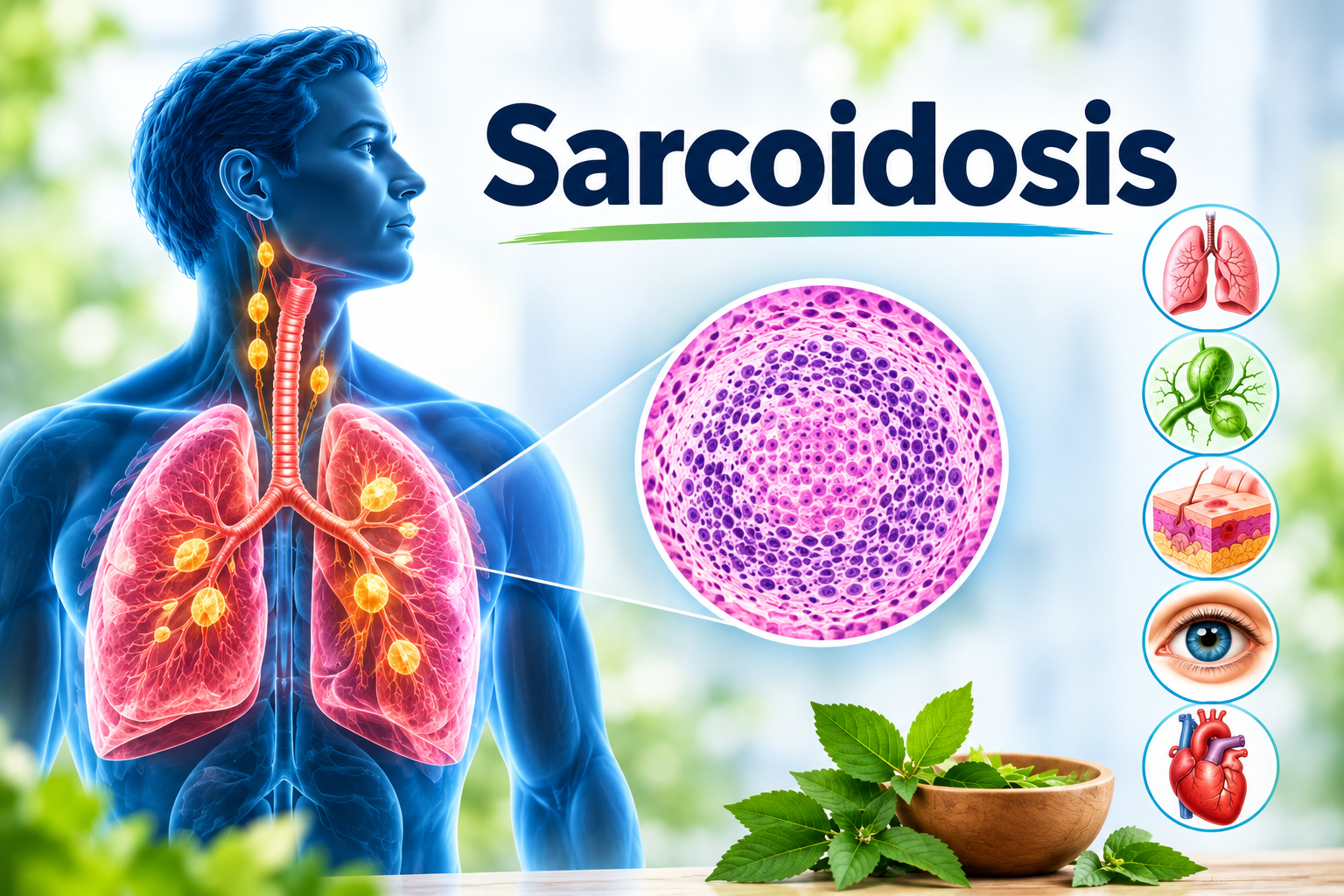
Sarcoid → refers to small, abnormal inflammatory lumps (granulomas) that can form in body tissues osis → means a condition or disease process. Sarcoidosis presents a diagnostic and therapeutic challenge because its manifestations differ substantially from one patient to another. The disease can develop gradually and remain unnoticed until abnormalities are identified on chest imaging or routine investigations. Respiratory involvement is particularly important, as persistent inflammation within the lungs can eventually affect pulmonary function and, in progressive cases, contribute to fibrosis. Extrapulmonary involvement further increases the complexity of the condition because the same disease process can produce different manifestations depending on the affected organ. Another important feature is its unpredictable course; some patients improve spontaneously, whereas others require prolonged monitoring and treatment.
Causes of Sarcoidosis
The exact cause of sarcoidosis is unknown. It is believed to develop from an abnormal immune response in genetically susceptible individuals.
Important proposed factors include:
- Genetic susceptibility – certain genetic factors may increase the risk.
- Immune system dysregulation – excessive immune activation promotes granuloma formation.
- Environmental exposures – dust, metals, chemicals, smoke, or other inhaled substances may act as triggers.
- Occupational exposure – higher exposure to certain workplace dusts and particles has been investigated as a risk factor.
- Infectious triggers – some microorganisms have been proposed as possible triggers, but no single infection has been established as the cause.
- Autoimmune-like immune reactions – abnormal immune responses to unidentified environmental antigens may contribute.
Pathogenesis of Sarcoidosis
Sarcoidosis develops through an abnormal cell-mediated immune response in genetically susceptible individuals. The main steps include:
- Trigger exposure: An unidentified environmental or infectious antigen may stimulate the immune system.
- Immune activation: Antigen-presenting cells activate CD4+ T lymphocytes, particularly Th1 cells.
- Cytokine release: Increased production of cytokines such as IL-2, IFN-gamma, and TNF-alpha promotes further immune-cell activation.
- Macrophage activation: Activated macrophages accumulate at the affected site and release inflammatory mediators.
- Granuloma formation: Macrophages transform into epithelioid cells and multinucleated giant cells, forming characteristic non-caseating granulomas.
- Organ involvement: Granulomas accumulate in organs such as the lungs, lymph nodes, skin, eyes, liver, and heart, producing organ-specific symptoms.
- Fibrosis in chronic disease: Persistent inflammation can lead to tissue remodeling and fibrosis, particularly in the lungs, resulting in progressive impairment of organ function.
Sarcoidosis can make Vitamin D metabolism behave differently
The granulomas contain activated macrophages that can produce 1-alpha-hydroxylase, converting 25-OH vitamin D into active 1,25-(OH)2 vitamin D (calcitriol). This can increase calcium absorption and lead to hypercalcemia or hypercalciuria. Therefore, simply finding a low 25-OH vitamin D level does not automatically mean that high-dose vitamin D supplementation is appropriate.
Types of Sarcoidosis
Sarcoidosis can be classified according to the organs predominantly affected:
- Pulmonary sarcoidosis – involves the lungs and is the most common form.
- Lymph node sarcoidosis – primarily affects the hilar and mediastinal lymph nodes.
- Cutaneous sarcoidosis – affects the skin, causing nodules, plaques, or erythema nodosum.
- Ocular sarcoidosis – involves the eyes and may cause uveitis, redness, pain, or visual disturbances.
- Cardiac sarcoidosis – affects the heart and may produce arrhythmias, palpitations, or heart failure.
- Neurosarcoidosis – involves the brain, spinal cord, or peripheral nerves.
- Hepatic sarcoidosis – affects the liver and may cause hepatomegaly or abnormal liver enzymes
- Multisystem sarcoidosis – involves two or more organs simultaneously.
Signs and Symptoms of Sarcoidosis
Symptoms vary depending on the organs involved. Some patients may have no symptoms and are diagnosed incidentally.
GENERAL SYMPTOMS
Persistent dry cough
Shortness of breath and chest discomfort
Fatigue and weakness
Fever and night sweats
Unintentional weight loss
Enlarged lymph nodes
Skin lesions or erythema nodosum
Eye redness, pain, or blurred vision
Joint pain and swelling
In severe cases: heart rhythm abnormalities or neurological symptoms.
Organ-Specific Manifestations
- Lungs: cough, breathlessness and reduced exercise tolerance.
- Skin: erythema nodosum, plaques, nodules or other characteristic skin lesions.
- Eyes: eye redness, pain, blurred vision or light sensitivity.
- Joints: joint pain and swelling, particularly around the ankles.
- Heart: palpitations, abnormal heart rhythm, fainting or, rarely, heart failure.
- Nervous system: headaches, weakness, sensory disturbances, seizures or cranial nerve involvement.
Stages of Pulmonary Sarcoidosis
Radiographic staging commonly includes:
- Stage 0: Normal chest X-ray.
- Stage I: Bilateral hilar lymphadenopathy without lung infiltrates.
- Stage II: Bilateral hilar lymphadenopathy with pulmonary infiltrates.
- Stage III: Pulmonary infiltrates without hilar lymphadenopathy.
- Stage IV: Pulmonary fibrosis and permanent structural lung damage.
Diagnosis of Sarcoidosis
Diagnosis is based on clinical features, imaging, and tissue findings, while excluding other causes of granulomatous disease.
- Chest X-ray/HRCT: shows bilateral hilar lymphadenopathy and/or pulmonary involvement.
- Biopsy: demonstrates characteristic non-caseating granulomas.
- Blood tests: CBC, liver/kidney function, serum calcium, and ACE level.
- Pulmonary function tests: assess respiratory impairment.
- Additional tests: ECG, eye examination, or organ-specific imaging when extrapulmonary involvement is suspected.
- Exclusion of other causes: particularly tuberculosis, fungal infections, and malignancy.
Modern Treatment of Sarcoidosis
- Corticosteroids: Prednisone/prednisolone is the main first-line treatment for symptomatic or organ-threatening disease.
- Steroid-sparing drugs: Methotrexate, azathioprine, leflunomide, or hydroxychloroquine may be used for persistent disease or to reduce steroid exposure.
- Biological therapy: Infliximab or other TNF-alpha inhibitors may be considered in selected refractory cases.
- Supportive care: Oxygen therapy, pulmonary rehabilitation, and treatment of specific organ complications when required.
- Advanced disease: Severe irreversible pulmonary disease may rarely require lung transplantation.
Treatment depends on organ involvement, disease severity, progression, and risk of permanent organ damage.
AYURVEDIC INSIGHT OF SARCODOSIS
In Ayurveda, sarcoidosis is understood not merely as an isolated immune defect, but as a systemic imbalance rooted in impaired metabolic fire (Agni) and toxin accumulation (Ama). While modern medicine views it as an inflammatory condition where the immune system forms microscopic clusters of inflamed cells (granulomas), classical Ayurveda correlates this presentation with a Sannipataja state (involving all three Doshas)—predominantly Kapha and Pitta—affecting the Rasa (plasma/lymph) and Rakta (blood) tissues.
Pathogenesis (Samprapti)
- Impaired Agni & Ama Creation: Poor digestion generates Ama (undigested toxic byproduct), which circulates through the channels (Srotas).
- Pitta Aggravation: Excess Pitta creates chronic heat and local tissue inflammation.
- Kapha Stagnation: Vitiated Kapha combines with Ama to form non-suppurative inflammatory nodules or nodular growths (Granthi or Arbuda). These commonly manifest in the lungs and lymph nodes as firm, structural congestions.
Management Philosophy
Rather than suppressing immunity, the Ayurvedic goal is to modulate it (Ojas stabilization) and dissolve blockages:
- Deepana & Pachana: Using digestive spices like Trikatu or Ginger to clear Ama and rekindle metabolic fire.
- Granthi-hara Formulations: Remedies like Kanchanar Guggulu help scrap away (Lekhana) stagnant nodular tissues.
- Immuno-Modulators (Rasayana): Herbs such as Guduchi (Giloy) and Turmeric (Curcumin) soothe inflammation while balancing overactive immune responses.
- Dietary Care: Avoiding heavy, greasy, dairy-heavy, or cold foods that worsen Kapha and Ama.
SARCODOSIS Herbal Remedies by Planet Ayurveda
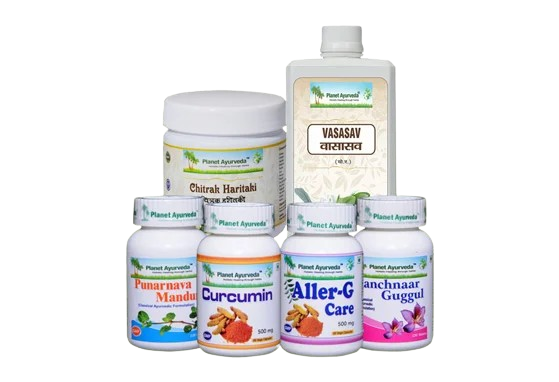
Planet Ayurveda is a trusted Ayurvedic wellness brand offering a wide range of traditionally inspired herbal formulations made with carefully selected ingredients. With a focus on quality, purity, and standardized manufacturing practices, Planet Ayurveda combines classical Ayurvedic knowledge with modern quality standards to provide wellness solutions for people worldwide. The Planet Ayurveda Sarcoidosis Care Pack is a thoughtfully selected combination of Ayurvedic formulations intended to support respiratory wellness, healthy immune function, and overall well-being.
- Curcumin Capsules
- Kanchnaar Guggul
- Aller-G Care
- Punarnava Mandur
- Chitrak Haritaki
- Vasasav
Herbal Remedies for Sarcoidosis

PRODUCT DESCRIPTION
1. Curcumin Capsules
Curcumin Capsules by Planet Ayurveda, prepared from standardized extract of Haridra (Curcuma longa), can be considered as supportive care in sarcoidosis because curcumin possesses anti-inflammatory and antioxidant properties. Sarcoidosis involves abnormal immune activation and persistent granulomatous inflammation; therefore, curcumin may provide supportive modulation of inflammatory pathways and help maintain cellular and tissue resilience. From an Ayurvedic perspective, Haridra is valued for its Shothahara (supporting healthy inflammatory response), Rakta-prasadana (supporting healthy blood and tissue physiology), and Tridosha-balancing properties.
Dosage: 1-2 Capsules twice daily, with plain water, after meals.
2. Kanchnaar Guggul
Kanchanar Guggulu contains Kanchanar (Bauhinia variegata), Trikatu (Shunti, Pippali and Maricha), Varuna (Crataeva nurvala), Triphala (Haritaki, Bibhitaki and Amalaki) and Guggulu (Commiphora mukul) etc. In sarcoidosis, it can be considered as a supportive Ayurvedic formulation when there is a tendency toward Kapha accumulation, tissue congestion, or abnormal glandular/lymphatic enlargement. Kanchanar and Guggulu are traditionally valued for Granthi-hara and Lekhana (supporting reduction of excessive tissue accumulation) actions, while Triphala supports digestion and tissue metabolism and Trikatu provides Deepana-Pachana (supporting digestive and metabolic function) activity. Varuna is traditionally used to support proper fluid movement and tissue function. Thus, Kanchanar Guggulu may have a role in an individualized Ayurvedic approach to sarcoidosis, particularly where lymph-node or tissue accumulation is prominent.
Dosage : 1-2 tablets twice or thrice daily with lukewarm water
3. Aller-G Care
Aller-G Capsules by Planet Ayurveda, containing Neem (Azadirachta indica), Haridra (Curcuma longa), Shirish (Albizia lebbeck) and Ashwagandha (Withania somnifera), can be considered as supportive care in sarcoidosis when inflammatory or immune-related manifestations are present. Haridra provides Shothahara (supporting healthy inflammatory responses) and antioxidant support, while Neem and Shirish are traditionally valued for Kapha-Pitta balancing (supporting regulation of structural/secretory and metabolic-inflammatory functions) and immune-related concerns. Ashwagandha contributes Rasayana (rejuvenative and restorative) and Balya (strength-supporting) properties. Together, these herbs may help support balanced immune function and tissue resilience.
Dosage: Take 1-2 Capsules twice daily, with plain water, after meals.
4. Punarnava mandoor
Punarnava Mandoor by Planet Ayurveda contains Punarnava (Boerhaavia diffusa), Shunti (Zingiber officinale), Pippali (Piper longum), Maricha (Piper nigrum), Amalaki (Emblica officinalis), Haritaki (Terminalia chebula), Chavya (Piper chaba), Haridra (Curcuma longa), Vidanga (Embelia ribes), Chitrak Mool (Plumbago zeylanica), and Mandoor Bhasma (ferric oxide calx) and is processed in cow’s urine. In sarcoidosis, it may be considered supportive Ayurvedic care where weakness, impaired digestion, nutritional deficiency, or tissue and fluid accumulation are present. Punarnava is traditionally valued for Shothahara (supporting healthy inflammatory balance) and fluid-regulating properties, while Shunti, Pippali, Maricha, Chavya, and Chitrak support Deepana-Pachana (digestive and metabolic function). Haridra and Amalaki provide antioxidant and tissue-supportive properties, while Mandoor Bhasma is traditionally used to support Rakta dhatu (blood tissue) and address iron-related nutritional weakness. In an Ayurvedic framework, the formulation may therefore support Agni (digestive and metabolic function), Kapha regulation, and overall tissue nourishment.
Dosage : 1-2 tablets twice or thrice daily with lukewarm water
5. Chitrak Haritaki
Planet Ayurveda’s Chitrak Haritaki contains Marich (Piper nigrum), Guduchi (Tinospora cordifolia), Dashmool, Yavakshar (alkaline preparation of barley, Hordeum vulgare), Pippali (Piper longum), Shunthi (Zingiber officinale), Ela (Elettaria cardamomum), Tejpatra (Cinnamomum tamala), Gud (jaggery) and Madhu (honey). The formulation provides a strong Deepana-Pachana (digestive and metabolic support) profile through herbs such as Marich, Pippali, Shunthi, Ela and Tejpatra. Guduchi provides Rasayana (rejuvenative and systemic restorative) support, while Dashmool is traditionally valued for Vata-related and respiratory complaints. The classical reference specifically describes Chitrak Haritaki for Agni vriddhi (improvement of digestive capacity), Kasa (cough), Pinasa (nasal and upper respiratory congestion) and Shwasa (breathing difficulty). Therefore, in sarcoidosis, particularly when respiratory manifestations are present, Planet Ayurveda’s Chitrak Haritaki can be considered as supportive Ayurvedic care based on the individual’s Dosha, Agni and overall clinical condition. It should be used under appropriate medical and Ayurvedic supervision alongside standard treatment for sarcoidosis.
Dosage : 5-10 gms once or twice a day after meals with milk.
6. Vasasav
Planet Ayurveda’s Vasasav contains Vasa (Adhatoda vasica), Pippali (Piper longum), Choti Ela (Elettaria cardamomum), Shitalchini (Cinnamomum tamala), Dalchini (Cinnamomum verum), Tejpatra (Cinnamomum tamala), Sugandhabala (Pavonia odorata), Nagakesar (Mesua ferrea), Dhatki Pushpa (Woodfordia fruticosa), Gur (jaggery) and Kali Mirch (Piper nigrum). Vasa is the key respiratory-supporting ingredient and is traditionally indicated for Kasa (cough) and Shwasa (breathing difficulty). Pippali and Kali Mirch provide Deepana-Pachana (digestive and metabolic support) and Kapha-balancing actions, while Dalchini, Ela and Tejpatra further support respiratory and digestive wellness. In sarcoidosis, particularly when respiratory manifestations such as persistent cough or breathing discomfort are present, Vasasav can be considered as supportive Ayurvedic care based on the individual’s Dosha, Agni and clinical presentation. It should be used under appropriate Ayurvedic and medical supervision and should not replace prescribed treatment for sarcoidosis.
Dosage-Take 3 tsp twice daily with equal amount of water or as advised by physician.
Diet in sarcoidosis
- Warm water or suitable herbal infusions instead of iced beverages.
- Avoid Excessive curd, especially at night.
- Alcohol and smoking should be avoided.
- Avoid Heavy, excessively oily and deep-fried foods.
- Spices such as dry ginger (Shunthi), cumin, coriander, turmeric and black pepper in food according to tolerance
- Emphasize a Mediterranean-style, anti-inflammatory dietary pattern like Vegetables and leafy greens, Fruits in appropriate portions , Legumes such as moong, lentils and chickpeas .
- Sarcoidosis can disturb calcium-vitamin D metabolism, so Limit Vitamin D supplementation and high-calcium loading; monitor serum/urine calcium levels regularly.
Lifestyle Management in Sarcoidosis
- Regular physical activity
- Breathing exercises
- Maintain a healthy weight
- Adequate sleep
- Avoid smoking, Limit alcohol
- Sunlight
CONCLUSION
Sarcoidosis is a complex multisystem inflammatory disorder that requires individualized assessment and regular medical monitoring. From an Ayurvedic perspective, management can be planned according to Dosha (functional regulatory principles), Agni (digestive and metabolic capacity), Ama (incompletely processed metabolic by-products), Bala (physical and functional strength) and the affected Srotas (physiological tissue and transport pathways). When respiratory manifestations such as Kasa (cough) and Shwasa (breathing difficulty) are present, treatment focuses on improving Agni and reducing Ama through appropriate Ahara (dietary management) and Deepana-Pachana (support of digestion and metabolism). Selected Shamana Chikitsa (symptom-oriented and disease-modifying supportive therapy) may be incorporated according to the individual’s presentation. In appropriately assessed patients, Shodhana (therapeutic purification procedures) may be considered under expert supervision, followed by Rasayana Chikitsa (rejuvenative and restorative care) to support Bala, tissue nourishment and recovery. Formulations such as Chitrak Haritaki and Vasasav can be considered for supportive respiratory and digestive care when clinically appropriate.


Dr. Vikram Chauhan
Latest posts by Dr. Vikram Chauhan (see all)
- Sarcoidosis: Causes, Symptoms & Ayurvedic Management - September 29, 2026
- Acidity & Heartburn: Antacids vs Ayurvedic Management of Amlapitta - September 28, 2026
- Fatty Liver: Causes, Symptoms, Diet & Ayurvedic Management - September 26, 2026
- Pigmented Villonodular Synovitis (PVNS): Symptoms, Causes & Treatment - September 25, 2026
- Idiopathic Thrombocytopenic Purpura (ITP): Causes, Symptoms, Treatment & Ayurveda - September 24, 2026