


Urinary Tract Infection (UTI): Causes, Symptoms & Ayurvedic Treatment
Abstract
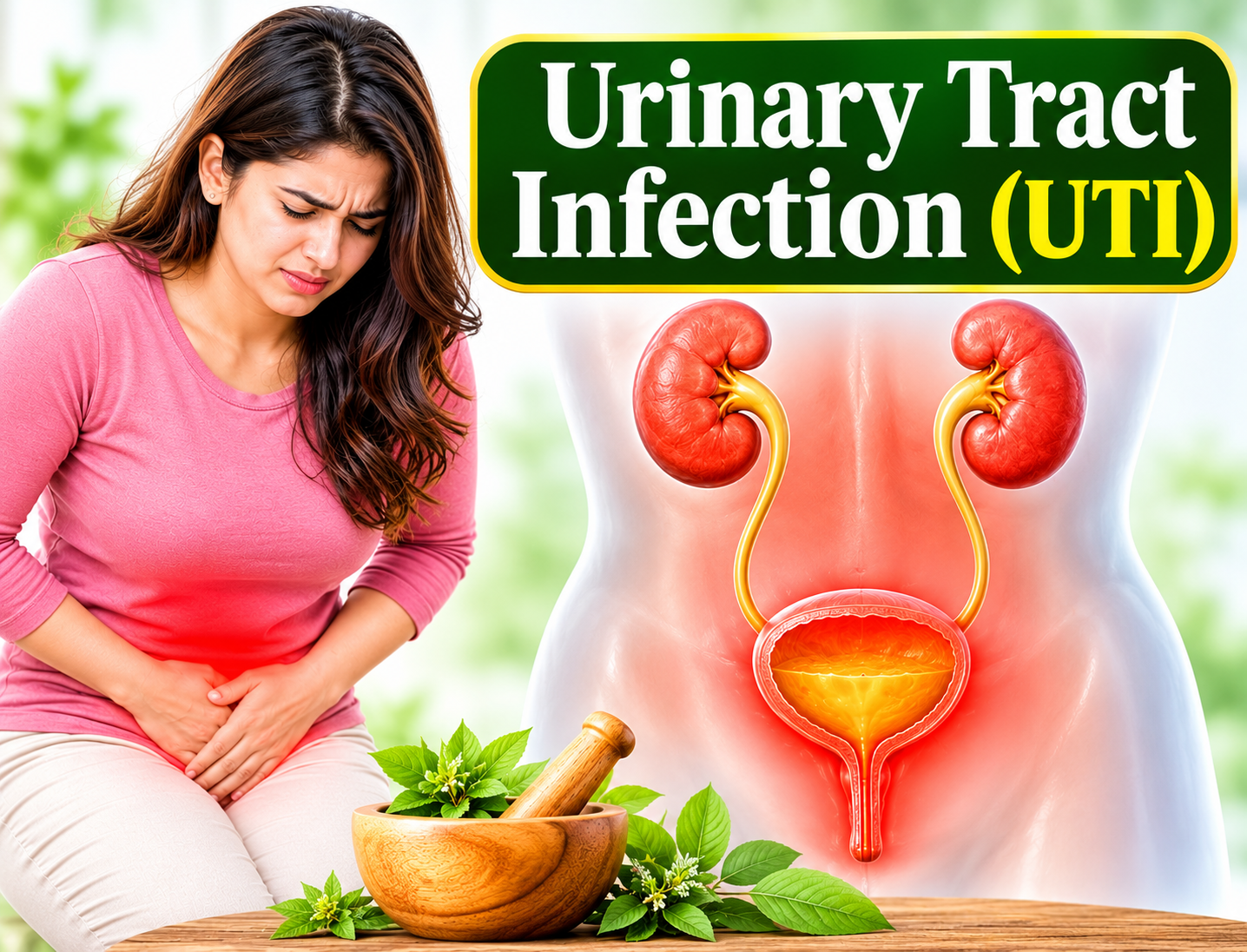
Urinary Tract Infection (UTI) is a prevalent clinical condition involving infection of the urinary tract and commonly presenting with dysuria, urgency, frequency, and lower urinary discomfort. Although Escherichia coli remains the predominant pathogen, recurrent episodes and antimicrobial resistance continue to create therapeutic challenges. Ayurveda describes several urinary disorders with overlapping manifestations, particularly Mutrakrichra (painful or difficult urination) and Mutradaha (burning micturition). These conditions are considered in relation to Dosha imbalance and disturbance of Mutravaha Srotas (urinary channels) . Let’s discuss this topic in detail.
Introduction
UTI is a major global health problem, affecting hundreds of millions of people each year and occurring substantially more often in women. Global estimates indicate around 449 million new UTI cases in 2021, including approximately 357 million among females . The urinary tract normally possesses several protective mechanisms that prevent the establishment of infection. When these defenses are disturbed, microorganisms may enter and multiply within the urinary tract, producing a spectrum of clinical manifestations collectively recognized as Urinary Tract Infection (UTI). Recurrent infection, urinary obstruction, calculi, diabetes, pregnancy, catheterization, incomplete bladder emptying, and inappropriate antimicrobial exposure may increase the risk.From the Ayurvedic viewpoint, the clinical presentation of UTI can be studied in relation to Mutrakrichra (painful or difficult micturition) and Mutradaha (burning micturition). These manifestations may involve vitiation of Vata and Pitta Dosha and disturbance of Mutravaha Srotas (urinary channels) मधुकोश (Madhukosha commentary on Madhava Nidana, Mutrakrichra Nidana): मूत्रस्य कृच्छ्रेण महता दुःखेन प्रवृत्तिः। (Madhukosha) Mutrakrichra is the condition in which urine is passed with great difficulty and discomfort.
Causes of Urinary Tract Infection (UTI)
Escherichia coli is the most common causative organism. UTI usually develops when microorganisms, mainly uropathogenic bacteria, enter the urinary tract and multiply. The important causes and predisposing factors include:
- Bacterial entry: Bacteria from the intestinal and perineal region can enter the urethra and travel upward into the bladder.
- Poor urinary hygiene: Inadequate personal hygiene may increase bacterial contamination around the urethral opening.
- Inadequate water intake: Low fluid intake reduces urine production and may decrease the natural flushing of microorganisms from the urinary tract.
- Holding urine for long periods: Repeatedly delaying urination can promote urinary stasis and provide more opportunity for bacterias to multiply .
- Female anatomy: The shorter female urethra allows bacteria to reach the bladder more easily, making UTI more common in female .
- Sexual activity: Sexual activity can facilitate the movement of bacteria towards the urethra and may contribute to recurrent UTI in some female .
- Incomplete emptying of the bladder: Residual urine can provide a favourable environment for bacterias to grow . It may occur with urinary obstruction, neurological disorders, or prostate enlargement.
- Urinary stones and obstruction: Stones or other obstructions can interfere with normal urine flow and increase the risk of UTI.
- Urinary catheterization: Catheters can provide a pathway for microorganisms to enter the urinary tract, particularly when used for prolonged period of time .
- Pregnancy and diabetes: Physiological changes during pregnancy and impaired immune or metabolic function associated with diabetes can increase susceptibility to UTI.
- Previous UTI: A history of UTI is an important risk factor for developing another episode, particularly when infections are recurrent.
- Antibiotic exposure and resistance: Repeated or inappropriate antibiotic use can select resistant bacteria, making subsequent infections more difficult to treat.
Pathophysiology
A urinary tract infection usually develops when uropathogenic bacteria, most commonly Escherichia coli, enter the urinary tract and overcome its normal protective mechanisms. Bacteria may ascend through the urethra into the bladder, where they attach to urothelial cells using structures such as fimbriae, multiply, and trigger a local immune and inflammatory response. This inflammation produces symptoms such as burning urination, urgency, frequency, and lower abdominal discomfort. If bacteria continue to ascend through the ureters, they may reach the kidneys and may cause pyelonephritis, leading to fever, chills, nausea, and flank pain. Factors such as urinary obstruction, incomplete bladder emptying, urinary stones, catheter use, sexual activity, and impaired host immunity can increase susceptibility. The body normally limits infection through regular urine flow, the bladder’s protective lining, antimicrobial substances in urine, and immune defenses.
Signs and Symptoms of UTI: When Urination Starts Sending Signals
- Burning urination: A burning or painful sensation while passing urine is one of the most common early symptoms of UTI and indicates irritation of the urinary tract.
- Increased frequency: The person may feel the need to urinate repeatedly, even when only a small quantity of urine is produced.
- Urinary urgency: A sudden, strong and difficult-to-postpone urge to urinate may occur.
- Incomplete bladder emptying: Some patients experience a persistent sensation that the bladder has not emptied completely after urination.
- Lower abdominal discomfort: Pressure, heaviness or discomfort may develop around the bladder or lower abdomen.
- Changes in urine: Urine may become cloudy, unusually foul-smelling, or occasionally blood-tinged, depending on the severity and cause of the infection.
- Systemic symptoms: Fever, chills, weakness, nausea or vomiting may indicate that the infection is extending beyond the lower urinary tract.
- Flank or back pain: Pain in the back or flank, particularly when associated with fever, may suggest upper urinary tract or kidney involvement and requires prompt medical evaluation.
Diagnosis of UTI
Diagnosing a UTI is like putting together a clinical puzzle—the symptoms provide the first clues, while urine investigations help confirm whether an infection is actually present.
- History: The First Clue – The evaluation usually begins with the patient’s symptoms. Burning micturition, increased frequency, urgency, lower abdominal discomfort, and cloudy or blood-tinged urine raise suspicion of UTI. Previous episodes, pregnancy, diabetes, urinary stones, catheter use, recent antibiotic exposure, and difficulty in emptying the bladder should also be assessed.
- Urine Routine Examination: Looking Inside the Urine-A urinalysis provides important evidence. The presence of leukocytes (white blood cells), leukocyte esterase, nitrites, and sometimes blood may support the diagnosis. However, these findings should be interpreted along with symptoms rather than in isolation.
- Urine Microscopy: Seeing the Cellular Evidence-Microscopic examination may demonstrate pyuria (increased white blood cells in urine) and, in some cases, bacteria or red blood cells. Pyuria indicates urinary tract inflammation but does not by itself prove bacterial infection.
- WBC ≥10/HPF → pyuria
- Bacteria present → supports bacteriuria
- RBC >5/HPF → may occur with UTI-associated hematuria
- Urine Culture: Identifying the Culprit- When infection needs confirmation—particularly in recurrent, complicated, or upper UTI, pregnancy, or treatment failure—a urine culture can identify the causative organism. It can also determine which antibiotics are likely to work through antimicrobial susceptibility testing.
- <10³ CFU/mL: Usually considered low-count growth; may represent contamination, but can occasionally be clinically significant in a symptomatic patient.
- 10³–10⁴ CFU/mL: May represent a clinically significant infection in symptomatic patients, particularly when a typical uropathogen is isolated.
- ≥10⁵ CFU/mL (100,000 CFU/mL): Traditionally considered significant bacteriuria, especially when a single pathogenic organism is isolated.
- Post-Void Residual (PVR) Urine: Measures urine remaining in the bladder after urination. Persistently >100 mL may suggest incomplete bladder emptying and warrants clinical assessment.
- CT/MRI of Urinary Tract: Considered when there is suspected obstruction, stone, abscess, structural abnormality, severe infection, or failure to improve after treatment.
Treatment
Modern UTI management depends on the site, severity, and clinical presentation of infection. Uncomplicated acute cystitis is commonly treated with oral antibiotics such as nitrofurantoin, fosfomycin, or trimethoprim-sulfamethoxazole, depending on local resistance and patient factors. Urine culture and antimicrobial sensitivity testing are particularly important in recurrent, complicated, atypical, or treatment-resistant infections. Pyelonephritis and severe systemic UTIs require antibiotics that reach renal tissue, with intravenous therapy or hospitalization when clinically necessary. Complicated UTIs also require evaluation for underlying causes such as stones, obstruction, urinary retention, or catheterization. Asymptomatic bacteriuria generally does not require treatment except in specific situations such as pregnancy or before selected invasive urological procedures.
Ayurveda Insight
In Ayurveda, the pathogenesis of UTI-like urinary disorders can be understood through Nidana Sevana (exposure to causative factors) leading to Agni Dushti (disturbed digestive and metabolic function) and subsequent Dosha Prakopa (functional imbalance of Doshas), particularly Pitta and Vata. Pitta aggravation may produce Mutradaha (burning micturition), while Vata aggravation may cause Mutrakrichra (painful or difficult urination). Continued Dosha imbalance can lead to Mutravaha Srotas Dushti (disturbance of the urinary channels) and Srotorodha (impaired passage or obstruction), resulting in Mutra Sanga (urinary stasis or incomplete emptying). In Ayurvedic understanding, Krimi (microbial involvement) may further contribute to the condition. Herbs used in UTI
- Gokshura (Tribulus terrestris): Gokshura (Tribulus terrestris) is one of the important Ayurvedic herbs used in disorders of the urinary system and it is traditionally described as Mutrakrichrahara (relieving painful or difficult urination) and Mutravirechaniya (promoting urinary flow). Its major phytoconstituents include steroidal saponins such as protodioscin, along with flavonoids and other polyphenolic compounds.
- Punarnava (Boerhavia diffusa):Punarnava (Boerhavia diffusa) is traditionally valued for its Murtala (promoting urine formation) and Shothahara (reducing inflammatory swelling) properties.. It has been studied for diuretic, anti-inflammatory and antioxidant effects.
- Varuna (Crataeva nurvala):Varuna (Crataeva nurvala) is traditionally used in disorders involving the urinary tract, particularly Mutraghata (difficulty or obstruction in urinary passage) and Ashmari (urinary calculi). Its important constituents include lupeol, friedelin and other triterpenoid compounds.
- Shatavari (Asparagus racemosus):Shatavari (Asparagus racemosus) possesses predominantly Madhura (sweet) and Sheeta (cooling) properties and is traditionally considered useful in Pitta-associated disorders. Its characteristic phytoconstituents are steroidal saponins known as shatavarins. The herb has anti-inflammatory, antioxidant and mucosal-supportive properties.
- Chandana (Santalum album):Chandana (Santalum album) is an important Dahaprashamana (relieving burning sensation) and cooling Ayurvedic drug. Its characteristic constituents include the sesquiterpene alcohols alpha-santalol and beta-santalol. Chandana is used in Pitta-dominant conditions characterized by heat and burning.
Herbal Remedies for UTI by Planet Ayurveda
Planet Ayurveda is a trusted name in Ayurvedic wellness, offering a wide range of traditionally inspired herbal formulations and wellness products. The brand focuses on combining classical Ayurvedic knowledge with modern manufacturing practices to maintain consistent quality and product standards. Planet Ayurveda provides products prepared from carefully selected herbs and plant-based ingredients, covering various wellness categories. The company follows established quality and manufacturing processes and serves customers in India as well as internationally. With a focus on Ayurveda, quality, and customer support, Planet Ayurveda aims to make traditional Ayurvedic formulations accessible to people seeking natural wellness options. For managing UTI we have lots of formulations out of which some are listed below
UTI CARE PACK


Products description
1. Punarnava Capsules
Punarnava Capsules are prepared in capsule form, with Punarnava (Boerhaavia diffusa) as the principal herbal ingredient. Punarnava is traditionally known for its Mutrala (supporting healthy urine formation and flow) and Shothahara (supporting reduction of swelling) properties. In urinary complaints, it is mainly used to support comfortable urination and normal fluid elimination.
Dosage- 1–2 capsules twice daily after meals with water, or as advised by an Ayurvedic physician.
2. Gokshuradi Guggul
Gokshuradi Guggul is available as a herbal tablet formulation containing Gokshura (Tribulus terrestris), Shuddha Guggulu (Commiphora mukul), Trikatu, Triphala and Mustaka (Cyperus rotundus).Triphala provides antioxidant and digestive support. Trikatu supports Deepana-Pachana (digestive and metabolic function) and may help in balancing Kapha-related factors Gokshura provides the main urinary-supportive component and supports healthy urinary passage.
Dosage- 1–2 tablets two to three times daily with lukewarm water, depending on the clinical requirement.
3. Varunadi Vati
Varunadi Vati is provided in tablet form and contains important herbs such as Varuna (Crataeva nurvala), Punarnava (Boerhaavia diffusa), Gokshura (Tribulus terrestris) and Shuddha Guggulu. The formulation is traditionally directed toward maintaining proper urinary flow and supporting the Mutravaha Srotas (urinary channels). Varuna is particularly valued in Ayurvedic practice when urinary symptoms are associated with Ashmari (urinary calculi) or obstruction-related discomfort.
Dosage- 1–2 tablets two to three times daily with lukewarm water.
4. Chandanadi Vati
Chandanadi Vati comes in tablet form and contains a combination of cooling and urinary-supportive herbs, including Chandana (Santalum album), Gokshura (Tribulus terrestris), Pashanabheda (Bergenia ligulata), Amalaki (Phyllanthus emblica) and other classical ingredients. Its main Ayurvedic role is particularly relevant when Mutradaha (burning during urination) is prominent. Chandana provides a naturally cooling profile, while the other ingredients support urinary comfort.
Dosage– 1–2 tablets two to three times daily with lukewarm water.
5. Reno Plan Syrup
Reno Plan is supplied as a liquid herbal syrup containing a combination of urinary-supportive herbs such as Punarnava (Boerhavia diffusa), Gokshura (Tribulus terrestris), Varuna (Crataeva nurvala) etc. Rather than relying on a single herb, this combination provides broader support for normal urinary elimination and fluid balance. Punarnava and Gokshura are traditionally used for urinary flow, while Varuna and other ingredients contribute additional urinary-system support.
Dosage– 1–2 teaspoons twice daily, preferably as directed by an Ayurvedic physician.
Conclusion
A urinary tract infection may start with something as simple as a burning sensation or frequent urge to urinate, but ignoring these early signals can allow the problem to progress. Proper diagnosis is therefore the first step toward effective management. Herbs and classical formulations may provide supportive care for urinary comfort and healthy elimination when selected appropriately. Along with treatment, adequate hydration, healthy urinary habits, personal hygiene, and correction of predisposing factors are important for prevention. Thus, managing UTI is not only about treating an infection—it is also about restoring and maintaining a healthy urinary system.


Dr. Vikram Chauhan
Latest posts by Dr. Vikram Chauhan (see all)
- Urinary Tract Infection (UTI): Causes, Symptoms & Ayurvedic Treatment - November 11, 2026
- Rheumatoid Arthritis: Ayurvedic Treatment, Herbs & RA Care - November 10, 2026
- Ketogenic Diet: Benefits, Foods, Weight Loss & Health Risks - November 6, 2026
- Herbal Remedies For Upadacitinib for IBD – Symptoms, Causes & Treatment in Ayurveda - November 5, 2026
- Autoimmune Disorders: Causes, Symptoms & Ayurvedic Management - November 4, 2026