


Idiopathic Thrombocytopenic Purpura (ITP): Causes, Symptoms, Treatment & Ayurveda
Abstract
Idiopathic thrombocytopenic purpura (ITP), now commonly termed immune thrombocytopenia, is an acquired autoimmune disorder characterized by isolated thrombocytopenia resulting from increased platelet destruction and impaired platelet production. It may occur at any age and can present with petechiae, purpura, easy bruising, mucosal bleeding, or, in severe cases, internal hemorrhage. Diagnosis is primarily based on clinical assessment, complete blood count, peripheral blood smear, and exclusion of other causes of low platelet counts. Management depends on platelet levels, bleeding severity, age, and associated conditions. Treatment options may include corticosteroids, intravenous immunoglobulin, thrombopoietin receptor agonists, rituximab, or splenectomy in selected cases. Early recognition and appropriate monitoring are important to reduce bleeding-related complications and improve patient outcomes.
Introduction
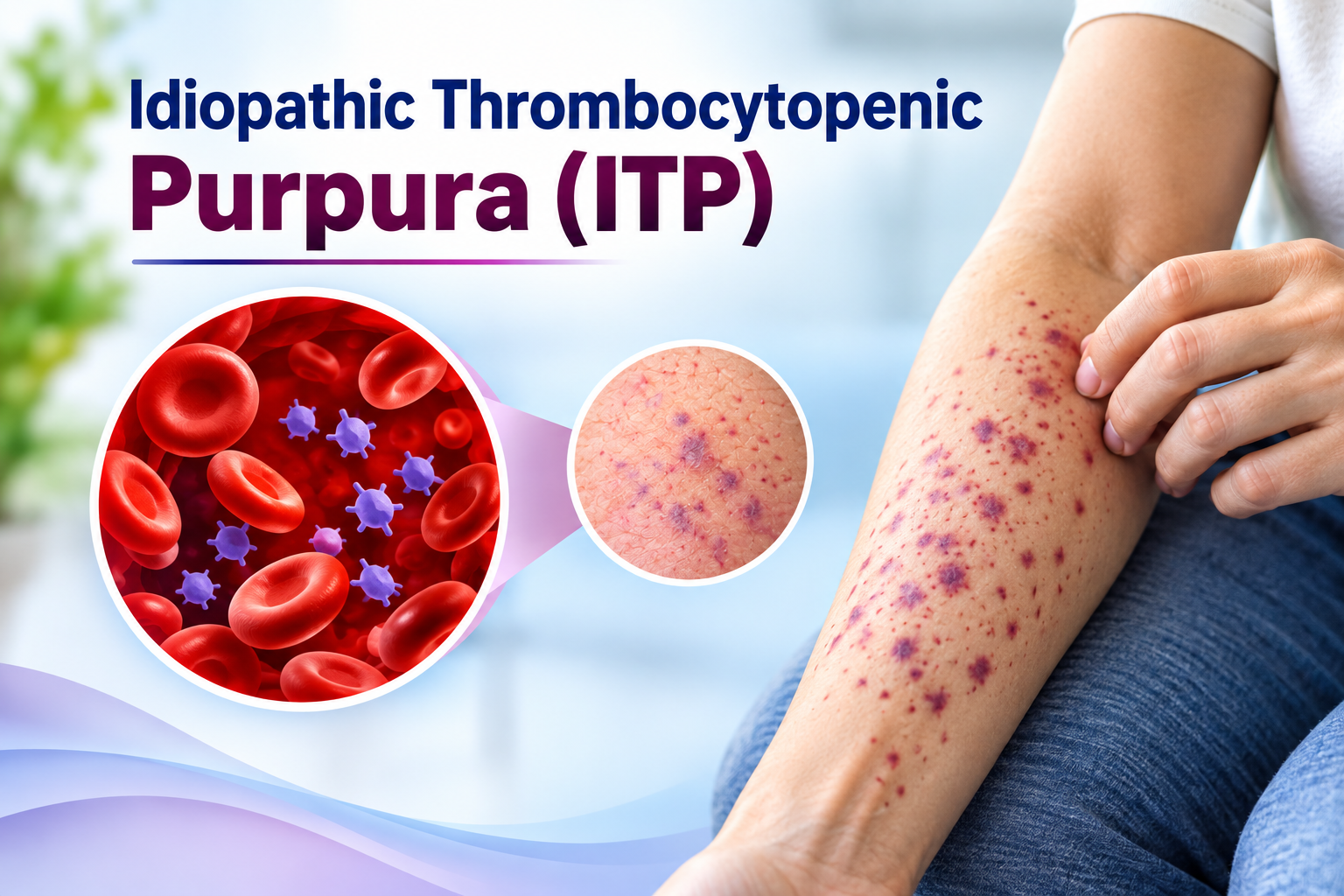
Idiopathic thrombocytopenic purpura (ITP), currently referred to as immune thrombocytopenia, is an acquired hematological disorder characterized by an abnormally reduced number of circulating platelets. Platelets are essential components of primary hemostasis, helping to maintain the integrity of blood vessels and prevent excessive blood loss following vascular injury. In ITP, abnormalities in immune regulation lead to increased platelet clearance and may also interfere with the normal production of platelets by megakaryocytes in the bone marrow. Its clinical presentation is highly variable. Some patients may have no noticeable symptoms and are diagnosed incidentally during routine blood investigations, whereas others may develop petechiae, purpura, spontaneous bruising, nosebleeds, gum bleeding, or excessive menstrual bleeding. Severe bleeding is uncommon but can become a serious complication when platelet levels are markedly reduced.
Statistics for Idiopathic Thrombocytopenic Purpura
ITP occurs across all age groups, with its frequency and clinical course varying between children and adults. The condition has an estimated annual occurrence of 50–100 cases per million people, while its overall prevalence is approximately 9.5 cases per 100,000 population. Among adults, around 3.3–6.6 cases per 100,000 people are reported annually, and diagnosis is most frequent between 56 and 60 years of age. Women, particularly those aged 30–60 years, are affected more often than men. In children, approximately 4–5 cases per 100,000 occur each year, with the highest occurrence between 2 and 4 years of age and a relatively similar distribution between sexes. The prognosis also differs by age: more than 70% of childhood cases resolve within six months, whereas approximately 25–30% may progress to chronic ITP. Adults have a greater tendency toward persistent disease, with about 67% experiencing chronic or prolonged ITP, often requiring continued follow-up.
Facts about Idiopathic Thrombocytopenic Purpura
- It mainly affects platelets: Platelets help the blood form clots. In ITP, the immune system mistakenly targets platelets, causing their number in the blood to decrease.
- The immune system plays a major role: The body may produce antibodies that attach to platelet
- A low platelet count does not always mean severe bleeding: Some people with ITP have very low platelet counts but experience only mild bruising or no symptoms, while others may develop significant bleeding.
- ITP can occur at any age: It occurs in both children and adults, although its pattern and clinical course can differ between these groups.
- The spleen is involved in platelet destruction: The spleen plays an important role in removing antibody-coated platelets from circulation, which is one reason it has historically been an important target in ITP treatment.
Causes of Idiopathic Thrombocytopenic Purpura
- Autoimmune reaction: The most important mechanism is an abnormal immune response in which antibodies target the body’s own platelets. These platelets are then removed from the bloodstream, mainly by the spleen.
- Previous viral infection: In children, ITP may develop after a recent viral infection. The infection can temporarily alter the immune response and cause the body to recognize platelets incorrectly.
- Certain infections: Some infections, including hepatitis C and HIV, have been associated with secondary ITP. Treating the underlying infection may be an important part of management.
- Medications: Certain medicines can cause immune-mediated destruction of platelets and produce an ITP-like condition. The specific medication history should therefore be reviewed by a healthcare professional.
- Helicobacter pylori infection: Infection with H. pylori, a bacterium associated with stomach disease, has been linked with ITP in some patients. Eradication therapy may improve platelet counts in selected cases.
- Immune system abnormalities: Changes in the balance and activity of immune cells can contribute to platelet destruction and impaired platelet production.
- Genetic or inherited factors: ITP itself is generally not an inherited disorder, although genetic differences in immune regulation may influence an individual’s susceptibility.
- Childhood triggers: In children, ITP often appears suddenly following an infection and may resolve naturally within several months.
- Unknown cause: In many patients, no specific underlying trigger can be identified. These cases are generally referred to as primary ITP.
Sign and Symptoms of Idiopathic Thrombocytopenic Purpura
- Easy bruising: Bruises may develop easily, sometimes without any obvious injury. They can appear as large blue, purple, or reddish patches on the skin.
- Petechiae: Small, pinpoint red or purple spots may appear on the skin, particularly on the legs and lower body. They occur due to tiny amounts of bleeding under the skin.
- Purpura: Larger areas of purple or reddish discoloration can develop when blood leaks beneath the skin.
- Nosebleeds: Frequent or prolonged nosebleeds may occur because of reduced platelet levels.
- Bleeding from the gums: The gums may bleed easily, especially after brushing or minor irritation.
- Heavy menstrual bleeding: Women with ITP may experience unusually heavy or prolonged menstrual periods.
- Prolonged bleeding from minor injuries: Small cuts or wounds may take longer than usual to stop bleeding.
- Blood in urine or stool: More significant thrombocytopenia can occasionally cause bleeding in the urinary or digestive tract, resulting in blood in the urine or black or bloody stools.
- Fatigue: Tiredness may occur, particularly when there is significant blood loss or anemia associated with bleeding.
- Heavy or unusual bleeding: In severe cases, bleeding may occur without an obvious injury and can require urgent medical attention.
Diagnosis of Idiopathic Thrombocytopenic Purpura
ITP is mainly diagnosed by identifying a low platelet count and ruling out other possible causes of thrombocytopenia
- Medical history: The doctor asks about bruising, bleeding, recent infections, medications, previous illnesses, and any history of bleeding disorders.
- Physical examination: The skin, mouth, gums, and other areas are examined for petechiae, purpura, bruising, or signs of bleeding.
- Complete Blood Count (CBC): This is an important initial test. It usually shows a low platelet count, while red and white blood cell counts are generally normal in typical ITP
- Peripheral Blood Smear: A blood sample is examined under a microscope to assess the appearance of blood cells and platelets and to exclude conditions that can resemble ITP.
- Platelet count monitoring: Repeated platelet counts may be performed to monitor changes over time and assess the response to treatment
Treatment for Idiopathic Thrombocytopenic Purpura
Treatment depends on the platelet count, severity of bleeding, age, and overall health. Mild cases may only require regular monitoring.
- Observation: Patients with mild symptoms and a safe platelet count may be monitored regularly without immediate medication.
- Corticosteroids: Medicines such as prednisone or dexamethasone are commonly used as initial treatment. They help reduce the immune response responsible for platelet destruction.
- Intravenous immunoglobulin (IVIG): IVIG can increase platelet levels relatively quickly and may be used when rapid improvement is needed, particularly during significant bleeding or before an urgent procedure.
- Thrombopoietin receptor agonists: Medicines such as eltrombopag or romiplostim can stimulate the bone marrow to produce more platelets and may be used in persistent or chronic ITP.
- Rituximab: This medicine reduces certain immune cells involved in antibody production and may be considered when ITP does not respond adequately to initial treatment.
- Splenectomy: Surgical removal of the spleen may be considered in selected patients with persistent or chronic ITP who do not respond sufficiently to medical treatment.
- Emergency treatment: Severe or life-threatening bleeding requires urgent hospital treatment, which may involve IVIG, corticosteroids, platelet transfusion, and other supportive measures.
- Regular follow-up: Platelet counts and bleeding symptoms should be monitored regularly to assess disease activity and treatment response.
Ayurvedic Insights
From an Ayurvedic perspective, idiopathic thrombocytopenic purpura (ITP) may be understood through the concepts of Rakta Dhatu, Pitta Dosha, Agni( digestive fire,) and Rakta Vaha Srotas. Although Ayurveda does not describe ITP as a distinct disease entity corresponding directly to its modern biomedical definition, its clinical features may be interpreted in relation to disturbances involving Rakta Dhatu and Pitta, along with impairment of Agni and physiological balance. Ayurvedic management traditionally emphasizes restoration of Dosha balance, improvement of digestion and metabolism, proper nourishment of the Dhatus, and maintenance of healthy bodily functions. Dietary measures may include fresh, nutritious, and easily digestible foods according to individual requirements. Adequate rest, stress management, and a balanced daily routine may also support overall wellbeing. These Ayurvedic concepts should be considered complementary and not a replacement for appropriate medical evaluation, platelet monitoring, or standard treatment of ITP.
Pathogenesis of Idiopathic Thrombocytopenic Purpura
In Ayurveda, idiopathic thrombocytopenic purpura (ITP) does not have a direct one-to-one disease equivalent, so its pathogenesis can only be interpreted through Ayurvedic concepts. It may be understood in relation to Rakta Dhatu, Rakta Vaha Srotas, and the involvement of Pitta Dosha, particularly when Rakta is affected. Disturbance in Agni(digestive fire) may lead to improper digestion and formation of inadequately nourished Dhatus. Continued Dosha imbalance may affect the quality and function of Rakta Dhatu and disturb its normal circulation and stability. Involvement of Vata Dosha may further contribute to irregular physiological functions and tissue depletion. From this perspective, impaired Agni( digestive fire), Dosha imbalance, and disturbance of Rakta Dhatu and its channels may collectively contribute to manifestations resembling bleeding tendencies.
Herbal remedies by Planet Ayurveda for Idiopathic Thrombocytopenic Purpura
Planet Ayurveda is a well-established Ayurvedic healthcare organization that works to promote the ancient knowledge of Ayurveda through natural remedies and holistic health solutions. The company develops a wide range of herbal formulations using pure, high-quality ingredients and standardized herbal extracts, with a focus on maintaining safety, authenticity, and effectiveness. Following the principles of classical Ayurveda, Planet Ayurveda aims to support overall health by addressing the underlying causes of health concerns and encouraging balance in the body, mind, and emotions. With an emphasis on quality, natural ingredients, and traditional approaches supported by modern research, the organization works toward making Ayurvedic wellness solutions available globally. We will explore various herbal approaches used for the management of Ulcerative Colitis according to Ayurvedic principles. The herbal formulations are;
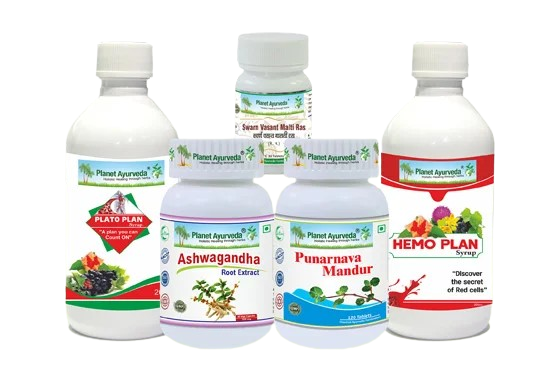
- Plato Plan Syrup
- Ashwanghanda Capsules
- Punarnava Mandur
- Hemoplan Syrup.
- Swarn Vasant Malti Ras
Idiopathic Thrombocytopenic Purpura (ITP)

Product description
1. Plato Plan Syrup
Plato Plan Syrup is an Ayurvedic herbal formulation containing Shigru (Moringa pterygosperma), Jeevanti (Leptadenia reticulata), Erand Karkati (Carica papaya), Wheat Grass (Triticum aestivum), Ashwagandha (Withania somnifera)) and Draksha (Vitis vinifera). Traditionally, these herbs are valued for their complementary roles in supporting overall nourishment and physiological balance. Erand Karkati is traditionally associated with blood and platelet wellness, while Giloy is valued for immune and general vitality support. Wheat Grass provides plant-based nutrients, and Ashwagandha is traditionally regarded as a Rasayana for strength and nourishment. Amalaki is valued for its antioxidant and rejuvenating properties. Shigru is traditionally used for digestive and metabolic support, while Jeevanti is considered nourishing and restorative. Draksha is traditionally valued for its nourishing and cooling qualities.
Dosage -2 tsp twice a day with plain water after meals
2. Ashwagandha Capsules
Ashwagandha Capsules contain Ashwagandha (Withania somnifera) as the primary herbal ingredient and may be used as a supportive Ayurvedic supplement in the overall management of Idiopathic Thrombocytopenic Purpura (ITP). In Ayurveda, Ashwagandha is traditionally regarded as a Rasayana herb associated with nourishment, strength, vitality, and support forphysiological balance. Its adaptogenic and antioxidant properties may provide general supportive benefits during periods of physical stress and weakness.
Dosage-1 Capsule twice a day with plain water after a meal.
3. Punarnava Mandur
Punarnava Mandur by Planet Ayurveda is a traditional Ayurvedic formulation containing Punarnava (Boerhaavia diffusa), Vidanga (Embelia ribes), Shunti (Zingiber officinale), Haritaki (Terminalia chebula), Chavya (Piper chaba), Haridra (Curcuma longa) and Ferric Oxide Calx (Mandoor Bhasma). In the supportive Ayurvedic management of idiopathic thrombocytopenic purpura (ITP), this combination is traditionally considered to promote healthy digestion, metabolism, nourishment, and overall physiological balance. Punarnava is traditionally valued for its rejuvenating and balancing properties, while Shunti, Pippali, Maricha, Chavya, and Chitrak are commonly used to support digestive function and bioavailability. Amalaki and Haritaki are valued for their restorative and antioxidant properties, while Haridra and Vidanga are traditionally used for systemic wellness. Mandoor Bhasma is traditionally included in Ayurvedic formulations for supporting healthy blood and iron-related nourishment.
Dosage- 2 tablets twice a day with plain water after meals.
4. Hemaplan Syrup
Hemo Plan Syrup is an Ayurvedic herbal formulation containing Manjistha (Rubia cordifolia), Shatavari (Asparagus racemosus), Draksha (Vitis vinifera), and Sariva (Hemidesmus indicus), Gorakhmundi (Sphaeranthus indicus), Ashwagandha (Withania somnifera). Hemo Plan is used as a supportive formulation for blood and haemoglobin wellness. Traditionally, Manjistha is valued for supporting healthy blood and circulation, Shatavari for nourishment and strength, Gorakhmundi for systemic and blood-related wellness, Ashwagandha as a rejuvenating herb, Draksha for nourishment, and Sariva for traditional blood-purifying properties.
Dosage– 2 tsp twice a day with plain water after meals.
5. Swarn Vasant Malti Ras
It is a classical Ayurvedic herbo-mineral formulation .The product contains Swarna Bhasma (gold calx), Kali Maricha (Piper nigrum), Mukta Bhasma (pearl calx), Shuddha Hingula (purified cinnabar), Kharpara/Rasaka, Shuddha Parad (purified mercury), and Shuddha Gandhak (purified sulphur), with lemon juice (Nimbu Swarasa) used as a traditional processing medium. Planet Ayurveda describes it as a classical preparation traditionally used for supporting vitality and healthy respiratory, digestive, and immune-system functions.. Its classical ingredients are traditionally considered to have Rasayana (rejuvenating), strengthening, and systemic-supportive properties. Swarna Bhasma and Mukta Bhasma are traditionally regarded as rejuvenative ingredients.
Dosage – 1 tablet chewed daily with luke warm water
Conclusion
At last it can be concluded that Idiopathic thrombocytopenic purpura (ITP), also known as immune thrombocytopenia, is an autoimmune condition in which platelet destruction and impaired platelet production can result in thrombocytopenia and an increased risk of bleeding. Proper diagnosis, regular platelet monitoring, and individualized medical treatment are important for preventing complications and maintaining overall health. From an Ayurvedic perspective, management may focus on restoring Agni (digestive fire), supporting healthy nourishment and Rakta Dhatu (blood tissue), maintaining Ojas, and promoting balanced immune function through appropriate diet, lifestyle.Traditionally used herbs such as Amalaki (Phyllanthus emblica), Guduchi (Tinospora cordifolia), Ashwagandha (Withania somnifera), Punarnava (Boerhaavia diffusa), and Draksha (Vitis vinifera) may be considered for supportive wellness .


Dr. Vikram Chauhan
Latest posts by Dr. Vikram Chauhan (see all)
- Idiopathic Thrombocytopenic Purpura (ITP): Causes, Symptoms, Treatment & Ayurveda - September 24, 2026
- Ulcerative Colitis: Symptoms, Causes & Ayurvedic Treatment - September 23, 2026
- Fatty Liver: Causes, Symptoms, Diet & Ayurvedic Management - September 22, 2026
- Ulcerative Colitis: Symptoms, Causes With Ayurvedic Treatment - September 21, 2026
- Immune Thrombocytopenia (ITP): Causes, Symptoms, Diagnosis & Treatment - September 19, 2026