


Foot Corn (Kadara): Causes, Symptoms and Ayurvedic Treatment
Abstract
A corn may look like a small patch of hard skin, but it is often the result of repeated pressure and friction acting on the foot. Reported prevalence varies across populations, with studies suggesting that corns and related hyperkeratotic lesions may affect around 14–48% of individuals, depending on age and other certain risk factors. Pain and tenderness can make routine walking uncomfortable. Management therefore focuses on relieving pressure, correcting footwear, cushioning the affected area, and removing excess keratin when required. Cryotherapy may be used in selected cases. From an Ayurvedic perspective, Kadara described in Sushruta Samhita offers a classical reference. Erand Oil, Nirgundi Oil, and foot soaking may provide supportive local care.Let’s discuss this in detail.
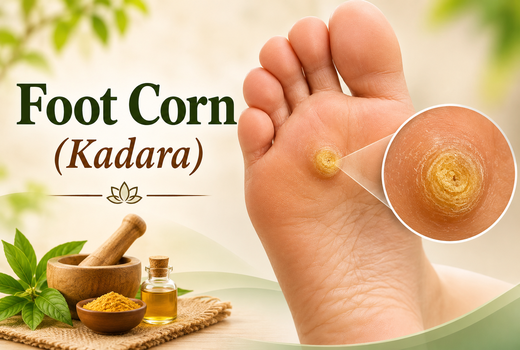
Definition
A corn is the skin’s way of saying, “Something is pressing on me too much.”A foot corn is a small, localized patch of thick, hard skin that develops when the skin experiences repeated pressure or friction. It is the foot’s natural attempt to protect itself from constant mechanical stress. With continued rubbing or pressure, extra keratin accumulates and forms a hard, concentrated area that may become tender or painful, especially while walking or wearing shoes. Rather than appearing randomly, corns usually form at places that repeatedly take the impact of walking, standing, or footwear . So, a foot corn is not simply “extra skin.
Types of Corns
- Hard corn (Heloma durum) – a firm, dry, well-defined thickening with a central hard core. It commonly occurs over the dorsum or sides of the toes because of pressure from footwear.
- Soft corn (Heloma molle) – a soft, whitish, macerated lesion, usually occurring between the toes, particularly between the 4th and 5th toes.
- Seed corn – small, superficial corns that generally occur on the sole and may be multiple.
- Vascular corn – a corn containing blood vessels; it may bleed during paring.
- Neurovascular corn – contains both nerve fibres and blood vessels and can therefore be markedly painful.
Corns commonly develop in areas where pressure and friction repeatedly meet, making certain parts of the foot more vulnerable than others. They frequently appear on the tops and sides of the toes, between the toes, at the tips of the toes, sole of the foot etc.
Causes And Risk Factors Of Foot Corns
- Tight or poorly fitting footwear: Narrow shoes can squeeze the toes and create continuous pressure on specific areas.
- High-heeled shoes: They shift more body weight toward the front of the foot, increasing pressure on the toes and ball of the foot.
- Repeated friction: Continuous rubbing between the skin, shoes, or adjacent toes encourages thickening of the skin.
- Prolonged standing or walking: Long periods of weight-bearing can repeatedly put stress on particular areas of the foot.
- Abnormal foot structure: Flat feet, high arches, or uneven weight distribution can concentrate pressure on certain parts of the foot.
- Toe deformities: Conditions such as hammer toes, claw toes, and bunions can create prominent areas that rub against footwear.
- Improper gait or biomechanics: An altered walking pattern can repeatedly overload specific pressure points.
- Moisture between the toes: Sweating and a damp environment increase friction and can contribute to the formation of soft corns.
- Age-related changes: With increasing age, the skin may become thinner and the natural cushioning or fat pads of the foot may decrease, changing pressure distribution.
- Occupational and lifestyle factors: Jobs or activities involving prolonged standing, walking, running, or repetitive foot pressure may increase the risk.
Corns Vs Warts
Corns and warts may look similar, but their causes are different. A corn develops due to repeated pressure and friction, commonly from tight footwear, abnormal toe position, or excessive pressure on the foot. It is usually firm, well-defined, and may have a central hard core. Pain is often felt when direct pressure is applied. A wart is a viral skin infection, commonly caused by human papillomavirus (HPV). Plantar warts may appear rough or irregular and can interrupt normal skin lines. Tiny dark dots may sometimes be visible.
Management
- Improve footwear: Choose comfortable, properly fitting shoes with a wide toe box to reduce pressure and friction.
- Use cushioning: Corn pads, soft insoles, gel cushions, or toe separators can protect the affected area and redistribute pressure.
- Paring or trimming: A healthcare professional can carefully remove the thickened keratin layer to reduce pain and pressure.
- Keratolytic treatment: Preparations containing salicylic acid may soften and gradually remove the thickened skin in selected patients.
- Correct foot mechanics: If abnormal walking patterns, flat feet, high arches, bunions, or toe deformities are causing repeated pressure, these problems should also be addressed.
- Cryotherapy in Foot Corns: Cryotherapy, also called cold therapy or cryosurgery, is a procedure in which extremely cold temperatures are used to destroy targeted skin tissue. Liquid nitrogen is the most commonly used clinical cryogen and can reach approximately -196°C. Freezing produces direct cellular injury, while the subsequent thawing process causes additional tissue damage, eventually allowing the treated tissue to separate and heal
Ayurveda Perspective
शर्करोन्मथिते पादे क्षते वा कण्टकादिभिः |मेदोरक्तानुगैश्चैव [१] दोषैर्वा जायते नृणाम् ||३०||
सकीलकठिनो ग्रन्थिर्निम्नमध्योन्नतोऽपि वा |कोलमात्रः सरुक् स्रावी जायते कदरस्तु सः ||३१|| (Ref: Sushrut Samhita 13/30-31)
Kadara develops in a person when the foot is injured or repeatedly traumatized, such as by stones, thorns, or similar objects. It may also develop due to the involvement of Doshas associated with Meda and Rakta (adipose tissue and blood) at the affected site.The resulting lesion is a hard, knot-like growth with a central depression or elevation. It is approximately the size of a Kola fruit (Indian jujube) and is associated with pain and sometimes discharge. Such a painful, hard, localized growth is described as Kadara.
Role Of Nirgundi Oil In Corn
Nirgundi oil, prepared from Vitex negundo, may be useful as a supportive topical approach for the discomfort associated with corns.
- Helps calm painful discomfort- A corn can become quite tender, especially when repeated pressure from footwear continues to irritate the area. Vitex negundo has shown analgesic (pain-relieving) activity in experimental research. Therefore, Nirgundi oil may offer supportive relief from the soreness and tenderness surrounding corn.
- Soothes local irritation and inflammation- Constant friction can leave the skin around a corn irritated and inflamed. Experimental studies on Nirgundi leaf oil have demonstrated topical anti-inflammatory activity, including effects involving cyclooxygenase-related inflammatory pathways. This provides a possible scientific basis for its soothing role.
- Supports comfort when friction continues- Nirgundi oil can be considered a comfort-supporting topical application when the area around a corn is irritated due to repeated friction or pressure. However, this benefit is based mainly on experimental evidence involving Vitex negundo and should not be interpreted as direct clinical evidence that Nirgundi oil treats corns.
- Ayurvedic view-Shothahara (anti-inflammatory), Vedanasthapana(analgesic/pain-relieving)- From an Ayurvedic perspective, Nirgundi is traditionally appreciated for its Shothahara and Vedanasthapana properties. In simple terms, it is traditionally used to help manage inflammation and pain. Hence, its potential role in corn can be understood as providing supportive relief from local discomfort rather than dissolving or removing the thickened skin itself.
Role Of Erand Oil On Corn
Erand Oil (Castor oil), obtained from Ricinus communis, may have a supportive role in managing the dryness, hardness and discomfort associated with corn.
- Softens the hardened skin- Corns develop as thick, hardened areas due to repeated pressure and friction. Castor oil is an emollient and may help soften and moisturize the thickened skin, making the area less dry and rough.
- Helps reduce dryness and cracking- Its oily, occlusive nature helps retain moisture in the skin, which may improve dryness and superficial cracking around a corn.
- May provide soothing comfort- Castor oil can help lubricate the affected area and reduce friction-related irritation. Its role here is mainly supportive for comfort, rather than removal of the corn.
- Ayurvedic perspective- Eranda (Ricinus communis) is traditionally described as Vatahara (helps pacify Vata) and Snigdha (unctuous). Because dryness and hardness are commonly associated with increased Rukshata (dryness) and Kathinya (hardness), its unctuous nature may be useful as supportive local care.
Role Of Foot Soaking In Corn
Foot soaking can be a simple supportive step in managing a corn. Soaking the feet in lukewarm water for about 10–15 minutes may help soften the thick, hardened skin and make it easier to care for. It can also help reduce dryness and roughness around the affected area. The warmth of the water may provide temporary relief from tenderness and discomfort. After soaking, the softened skin can be gently cleaned. Foot soaking is supportive care and does not address the pressure or friction responsible for the corn.
Conclusion
A corn may appear to be just a small hard spot on the foot, but it is often a visible sign of repeated pressure and friction happening underneath. Therefore, simply removing the thickened skin is not always enough—the cause of that pressure also needs attention. Cryotherapy can be considered in selected cases, while proper footwear, cushioning, and pressure reduction help support long-term care. Simple measures such as lukewarm foot soaking may soften the hardened skin and improve comfort, whereas Erand Oil and Nirgundi Oil can be used for dryness, hardness, irritation, and local discomfort.


Dr. Vikram Chauhan
Latest posts by Dr. Vikram Chauhan (see all)
- Foot Corn (Kadara): Causes, Symptoms and Ayurvedic Treatment - November 17, 2026
- Fatty Liver: Causes, Symptoms & Ayurvedic Treatment - November 16, 2026
- Chronic Kidney Disease (CKD): Causes & Ayurvedic Care - November 13, 2026
- Ulcerative Colitis: Causes, Symptoms & Ayurvedic Treatment - November 13, 2026
- Urinary Tract Infection (UTI): Causes, Symptoms & Ayurvedic Treatment - November 11, 2026