


Upadacitinib for Rheumatoid Arthritis: JAK1 & Ayurveda
Upadoz / Upadacitinib: The JAK1 Switch Turning Down Inflammation In Rheumatoid Arthritis
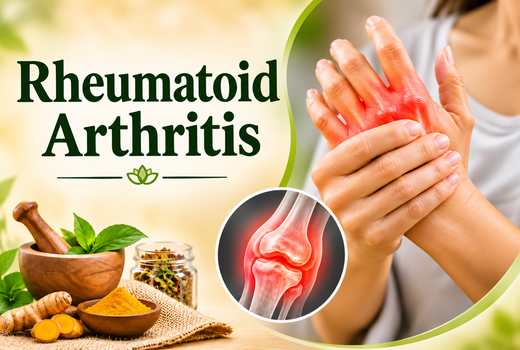
Imagine waking up and discovering that your hands have become strangely unfamiliar. The fingers are stiff. The knuckles are swollen. Closing the hand is difficult, and something as ordinary as opening a bottle suddenly requires effort. The stiffness may slowly loosen as the morning progresses, only to return again the next day. Now imagine that this is not an occasional episode but a persistent process occurring inside the body. This is the reality of rheumatoid arthritis (RA), a chronic inflammatory autoimmune disease that affects much more than the joints. According to the World Health Organization, approximately 18 million people worldwide were living with rheumatoid arthritis, contributing around 2.4 million years lived with disability, based on Global Burden of Disease 2019 estimates. But what makes the joints remain inflamed? The answer lies partly in a microscopic conversation happening inside immune cells. Cytokines continuously send inflammatory messages. Their receptors receive these signals, and intracellular proteins known as Janus kinases (JAKs) help transmit them further into the cell. One of the important members of this system is JAK1. This creates an intriguing therapeutic idea:
What if the inflammatory message could be turned down before it produces its full effect?
This is where upadacitinib enters the story. Upadacitinib is an oral, targeted synthetic disease-modifying antirheumatic drug (DMARD) that preferentially inhibits JAK1-dependent signaling. Rather than acting simply as a conventional pain-relieving medicine, it interferes with intracellular signaling pathways involved in immune and inflammatory responses. The result is not the complete elimination of the immune response. Instead, the objective is to reduce excessive inflammatory signaling. And this is the story behind the phrase: “The JAK1 switch turning down inflammation.”
Rheumatoid Arthritis: When the Immune System Changes Its Conversation
Under normal circumstances, the immune system is designed to recognize and respond to threats. In rheumatoid arthritis, however, immune regulation becomes abnormal. The synovial tissue surrounding joints becomes infiltrated by inflammatory cells and mediators. Persistent inflammation can produce synovial proliferation, cartilage damage and progressive bone erosion.
The clinical picture may include:
- Persistent joint pain
- Swelling and tenderness
- Prolonged morning stiffness (lasts for one hour or longer )
- Reduced joint mobility
- Fatigue
- General weakness
- Difficulty performing daily activities
- Progressive structural joint damage in uncontrolled disease
RA may also involve organs beyond the joints. Therefore, modern treatment does not focus merely on making a painful joint feel better for a few hours. The larger objective is disease modification—reducing inflammatory activity, maintaining physical function and limiting structural damage.
The Hidden JAK-STAT Conversation
- To understand upadacitinib, imagine a cytokine as a messenger carrying an inflammatory instruction.
- The messenger reaches the cell and interacts with its receptor.
- The message then has to travel from the cell membrane toward the nucleus.
The simplified pathway looks like this:
Cytokine
↓
Cytokine receptor
↓
JAK activation
↓
STAT activation
↓
Changes in gene transcription
↓
Cellular inflammatory response
This is broadly known as the JAK-STAT signaling pathway. Several cytokines use JAK-dependent signaling. Because multiple inflammatory pathways converge on JAK proteins, these enzymes became important targets in the development of newer therapies for immune-mediated diseases. Upadacitinib is designed to inhibit JAK signaling, with greater functional selectivity for JAK1 than some other JAK family members. Thus, instead of neutralizing only one extracellular inflammatory messenger, the medicine acts further downstream at the level of intracellular signaling.
What Exactly Is Upadacitinib?
Upadacitinib is a small-molecule JAK inhibitor administered orally.
Its therapeutic concept can be simplified as:
Upadacitinib
↓
JAK1 inhibition
↓
Reduced phosphorylation/activation of downstream STAT proteins
↓
Reduced signaling from several cytokine pathways
↓
Reduced inflammatory activity
This mechanism explains why JAK inhibitors are sometimes described as targeted synthetic DMARDs. What Happens When the Switch Is Turned Down? The immune system protects the body. Therefore, manipulating immune signaling inevitably raises another question: Can reducing inflammatory signaling also reduce some protective immune functions?
This is why JAK inhibitor therapy requires medical supervision.
Important safety considerations include:
Infections
JAK inhibition can increase susceptibility to infections. Herpes zoster is an especially recognized concern with JAK inhibitor treatment.
Blood-count abnormalities
Changes in neutrophils, lymphocytes and other hematological parameters may occur and may require laboratory monitoring.
Liver and lipid parameters
Treatment may produce changes in liver-related laboratory values and lipid levels.
Cardiovascular and thromboembolic considerations
JAK inhibitor therapy requires assessment of cardiovascular and thromboembolic risk, particularly in patients with relevant risk factors.
Malignancy and skin cancer considerations
Long-term safety surveillance includes malignancy and non-melanoma skin cancer monitoring. This does not mean that every patient taking upadacitinib will develop these complications. Rather, it means that the benefit-risk profile must be evaluated individually.
AYURVEDIC VIEW OF RA: A Different Story of Inflammation.
But then comes an intriguing question: What if the story of rheumatoid arthritis begins long before inflammation reaches the joint?
What if, instead of asking only which inflammatory pathway is switched on, we ask, what happened inside the body that allowed this disturbance to develop in the first place? This is where Ayurveda begins telling a very different story. While modern medicine follows the inflammatory signal into the microscopic world of cytokines, JAKs and STAT proteins, Ayurveda takes the reader back to Agni—the body’s transformative and digestive force. Imagine the body as a carefully maintained fire. When Agni becomes weakened, Ayurveda describes the possibility of Ama formation, representing incompletely processed material. When Ama interacts with aggravated Vata, it may circulate through the body and eventually localize in vulnerable sites such as the joints. This is where the Ayurvedic concept of Amavata begins to resemble the clinical picture of rheumatoid arthritis, with manifestations such as pain, swelling, stiffness and restricted movement. And the contrast is fascinating.Modern medicine asks: Which molecular signal is keeping inflammation active? Ayurveda asks: What disturbance in the body’s internal balance allowed the disease process to develop?
In the JAK-STAT model, attention moves toward intracellular signaling and cytokine pathways. In the Ayurvedic model, attention expands toward Agni, Ama, Vata, Ahara, Vihara and individual constitutions. One looks closely at the molecular switch; the other looks at the terrain surrounding the disease. Ayurveda therefore does not describe Amavata simply as a joint problem. It presents a broader sequence: Mandagni → Ama formation → Vata aggravation → localization in the joints → pain, swelling and stiffness.
These are different medical frameworks, and Amavata should not be declared identical to rheumatoid arthritis. Yet this contrast makes the discussion fascinating: modern medicine attempts to turn down a specific inflammatory signaling pathway, while Ayurveda approaches the patient through digestion, metabolism, dosha balance, diet and lifestyle.
- Two different languages.
- Two different ways of looking at disease.
- One complex inflammatory experience.
And that is where the conversation between modern rheumatology and Ayurveda becomes truly interesting.
Ayurvedic Drugs: A Different Approach to Inflammation
Haridra – Curcuma longa
- Rasa: Tikta, Katu
- Guna: Laghu, Ruksha
- Virya: Ushna
- Vipaka: Katu
- Major constituents: Curcumin, demethoxycurcumin, bisdemethoxycurcumin
- Inflammatory relevance: Curcumin has been studied for modulation of NF-kB, MAPK and other inflammatory pathways.
Shallaki – Boswellia serrata
- Rasa: Tikta, Kashaya
- Guna: Laghu, Ruksha
- Virya: Ushna
- Vipaka: Katu
- Major constituents: Boswellic acids, particularly AKBA
- Inflammatory relevance: Boswellic acids have been investigated for effects on 5-LOX, NF-kB and inflammatory mediators.
Guduchi – Tinospora cordifolia
- Rasa: Tikta, Kashaya
- Guna: Laghu, Snigdha
- Virya: Ushna
- Vipaka: Madhura
- Major constituents: Tinosporaside, tinosporine, cordifol, columbin
- Inflammatory relevance: Experimental studies suggest immunomodulatory and anti-inflammatory effects, including effects on cytokine and JAK/STAT-related signaling.
Ashwagandha – Withania somnifera
- Rasa: Madhura, Tikta, Kashaya
- Guna: Guru, Snigdha
- Virya: Ushna
- Vipaka: Madhura
- Major constituents: Withanolides, particularly withaferin A
- Inflammatory relevance: Experimental research suggests modulation of NF-kB and inflammatory cytokines.
Guggulu – Commiphora wightii
- Rasa: Tikta, Katu, Kashaya
- Guna: Laghu, Ruksha
- Virya: Ushna
- Vipaka: Katu
- Major constituents: E- and Z-guggulsterone
- Inflammatory relevance: Guggulsterones have been investigated for effects on several inflammatory signaling pathways.
Planet Ayurveda RA Care Pack
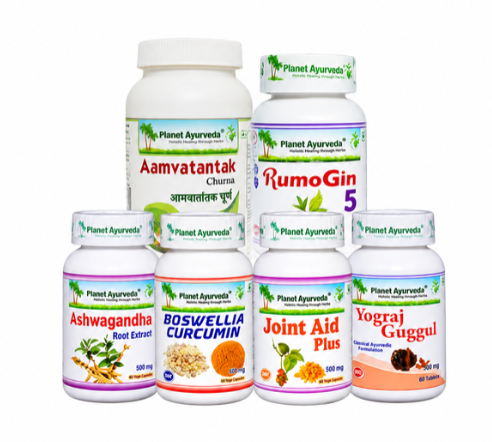
Planet Ayurveda is an Ayurvedic healthcare and wellness brand offering a wide range of herbal formulations based on traditional Ayurvedic principles and classical knowledge. Its product range includes capsules, tablets, powders, syrups, oils and specialized herbal combinations prepared using carefully selected herbs and standardized extracts. Planet Ayurveda RA Care Pack is formulated around several traditionally used Ayurvedic ingredients, including Boswellia (Shallaki), Ashwagandha, Guggulu, Haridra and other herbs traditionally associated with joint and inflammatory support. The Planet Ayurveda RA Care Pack includes these six products:
- Boswellia Curcumin
- Aamvatantak Churna
- Ashwagandha Capsules
- Joint Aid Plus
- RumoGin 5 Capsules
- Yograj Guggul
RA CARE PACK

Product description
1. Boswellia Curcumin
Boswellia Curcumin is a standardized herbal capsule formulation combining Shallaki (Boswellia serrata) and Curcumin/Haridra (Curcuma longa), two herbs traditionally used in Ayurveda for joint comfort and inflammatory conditions. The formulation is intended to support joint mobility, flexibility and comfort and may be included in an Ayurvedic approach for RA-associated pain, stiffness and swelling. Boswellia provides boswellic acids, while turmeric provides curcuminoids.
Dosage: 2 capsules twice daily with warm water after meals.2. Aamvatantak Churna
Planet Ayurveda Aamvatantak Churna is a powdered Ayurvedic polyherbal formulation designed around the classical Ayurvedic concept of Amavata, which is commonly correlated with rheumatoid arthritis in Ayurvedic literature. It contains Ashwagandha (Withania somnifera), Methi (Trigonella foenum-graecum), Haridra (Curcuma longa) etc. These herbs are traditionally used to support digestion, manage Ama-related symptoms and maintain joint comfort.
Dosage: 1 teaspoon twice daily with warm water.
3. Ashwagandha Capsules
Ashwagandha Capsules contain standardized root extract of Ashwagandha (Withania somnifera), traditionally classified as a Rasayana and Balya herb in Ayurveda. Each vegetarian capsule contains 500 mg standardized Ashwagandha root extract. In an Ayurvedic RA-support approach, Ashwagandha is included primarily for its traditional role in supporting strength, nourishment of muscles and tissues, physical resilience and Vata balance, rather than as a direct disease-modifying RA agent. It may therefore complement formulations directed toward joint comfort and musculoskeletal support.
Dosage: 2 capsules twice daily with warm water after meals.
4. Joint Aid Plus
Joint Aid Plus is a polyherbal capsule formulation combining herbs traditionally used for musculoskeletal and joint support. Each capsule contains Nirgundi (Vitex negundo), Shallaki (Boswellia serrata) Guggul (Commiphora mukul) etc. The combination provides herbs traditionally associated with Vata management, joint comfort, mobility and musculoskeletal strength. It may be included in an Ayurvedic RA-support regimen for stiffness, discomfort and restricted movement.
Dosage: 2 capsules twice daily with warm water after meals.
5. RumoGin 5 Capsules
RumoGin 5 Capsules is a five-herb formulation containing Haridra (Curcuma longa) 200 mg, Sonth (Zingiber officinale), Shallaki (Boswellia serrata) etc. The formulation is traditionally positioned for joint comfort, stiffness and musculoskeletal support, while its digestive herbs also support proper digestion and Ayurvedic management of Ama. For RA-related symptoms, it can be used as part of a broader Ayurvedic regimen aimed at maintaining comfortable movement and reducing the burden of joint discomfort.
Dosage: 1 capsule twice daily with warm water after meals.
6. Yograj Guggul
Yograj Guggul is a classical Ayurvedic tablet formulation traditionally associated with Vata-related musculoskeletal conditions. It contains purified Guggul (Commiphora mukul) along with herbs including Mustaka (Cyperus rotundus), Chitraka (Plumbago zeylanica), Amalaki (Emblica officinalis), Bibhitaki (Terminalia bellirica), Haritaki (Terminalia chebula), Pippali (Piper longum), Ajwain (Carum copticum), Vidanga (Embelia ribes), Gokshura (Tribulus terrestris), Jeeraka (Cuminum cyminum) and other classical ingredients. Traditionally, it supports Vata balance, digestion, joint comfort and musculoskeletal function.
Dosage: 2 tablets twice daily with warm water after meals.
Conclusion
Rheumatoid arthritis is more than just joint pain. It is a long-term condition in which an overactive immune response can gradually affect movement, daily activities and joint health. Upadacitinib offers a modern approach by reducing specific inflammatory signals involved in the disease.Ayurveda looks at the condition from a different perspective. Instead of focusing only on inflammation, it considers Agni, Ama, Vata, diet, lifestyle and individual body constitution. The concept of Amavata provides a traditional Ayurvedic way of understanding symptoms such as pain, swelling and stiffness. Herbs such as Haridra, Shallaki, Guduchi, Ashwagandha and Guggulu have traditionally been used to support joint health. The Planet Ayurveda RA Care Pack, containing Boswellia Curcumin, Aamvatantak Churna, Ashwagandha Capsules, Joint Aid Plus, RumoGin 5 and Yograj Guggul, follows this broader Ayurvedic approach. The modern and Ayurvedic systems explain RA in different ways, but both ultimately focus on an important goal: helping the patient manage the disease, maintain mobility and protect quality of life.


Dr. Vikram Chauhan
Latest posts by Dr. Vikram Chauhan (see all)
- Metformin: Uses, Benefits, Side Effects & Ayurvedic Support - November 18, 2026
- Upadacitinib for Rheumatoid Arthritis: JAK1 & Ayurveda - November 18, 2026
- Foot Corn (Kadara): Causes, Symptoms and Ayurvedic Treatment - November 17, 2026
- Fatty Liver: Causes, Symptoms & Ayurvedic Treatment - November 16, 2026
- Chronic Kidney Disease (CKD): Causes & Ayurvedic Care - November 13, 2026