


PCOS Treatment in Ayurveda: Causes, Symptoms & Management
ABSTRACT
Polycystic Ovarian Syndrome (PCOS) is a common hormonal problem in women of reproductive age. It can cause irregular periods, difficulty in ovulation, acne, unwanted hair growth, weight gain, and fertility problems. Hormonal imbalance, insulin resistance, stress, unhealthy food habits, and lack of physical activity can contribute to PCOS. In Ayurveda, its symptoms can be understood through Artava Dushti, Anartava, Agnimandya, Meda Dushti, Kapha-Vata imbalance, and Srotorodha. Ayurveda focuses on correcting the root causes through proper diet, regular exercise, weight management, stress control, improving digestion and metabolism, and suitable individualized therapies. Let’s discuss it in detail!
INTRODUCTION
“Polycystic Metabolic-Ovarian Syndrome (PMOS) is a proposed broader terminology for PCOS that emphasizes the important metabolic, hormonal, ovarian, and reproductive components of the disorder.” Myth: PCOD/PCOS occurs only in overweight or obese women. Fact: PCOD/PCOS can affect women of any body type, including those who are lean or have a normal BMI. Polycystic Ovary Syndrome (PCOS) is a common endocrine and metabolic disorder affecting women of reproductive age. This condition is characterized mainly by hyperandrogenism (increased androgens )and abnormalities of ovulation, which commonly present as irregular, infrequent, or absent menstrual periods. Women may develop clinical features of increased androgen activity, such as hirsutism, acne, and excessive hair growth, while some may have elevated androgen levels without physical symptoms.PCOD is also frequently associated with insulin resistance, obesity, dyslipidemia, infertility, and other metabolic abnormalities. The ovarian dysfunction results in irregular or absent ovulation, which can make conception difficult.
CAUSES
PCOS does not occur because of one particular reason. It usually develops due to a combination of genetic, hormonal, metabolic, and lifestyle factors.
- Genetic tendency:- PCOS can run in families. If a mother or sister has PCOS, the chances of developing it may be higher.
- Insulin resistance:- In some women, the body does not use insulin properly. As a result, the pancreas produces more insulin. High insulin levels can stimulate the ovaries to produce more androgens, disturbing normal ovulation.
- Hormonal imbalance: Women with PCOS may have increased levels or activity of androgens. This can interfere with the normal development of ovarian follicles and cause symptoms such as acne, unwanted facial hair, and irregular periods.
- Abnormal LH secretion: Changes in the release of luteinizing hormone (LH) can increase androgen production from the ovaries. This may interfere with the normal growth of the egg-containing follicles and ovulation.
- Overweight and obesity: Excess body fat can worsen insulin resistance and hormonal imbalance. This can further disturb menstrual cycles and ovulation.
- Unhealthy diet and lack of exercise: Frequent intake of high-calorie or highly processed foods and physical inactivity can promote weight gain and insulin resistance, which may worsen PCOS symptoms.
- Adrenal androgen excess: In some women, the adrenal glands produce higher amounts of androgen hormones. This can add to the overall hormonal imbalance seen in PCOS.
PATHOLOGY OF PCOS
PCOS is a complex hormonal and metabolic disorder in which normal ovarian function and ovulation become disturbed. The pathology can be understood as follows:
- Insulin resistance → increased insulin- The body becomes less sensitive to insulin, so the pancreas produces more insulin. High insulin stimulates the ovaries to produce more androgens leads to increased active androgen levels. This can be correlated with Agnimandya (decreased digestive fire )and Meda Dushti(disturbed fat metabolism ), and excessive Meda (metabolic disturbance).
- Increased androgen production- Excess androgen interferes with normal follicular development. Small follicles may start developing but fail to mature properly. This can be understood through Kapha-Meda predominance with Vata disturbance, affecting normal functioning of Artavavaha Srotas(menstrual and reproductive function ).
- Disturbed follicular development- Because follicles do not mature normally, ovulation may not occur regularly. This leads to oligo-ovulation or anovulation.Irregular or absent menstruation can be correlated with Artava Dushti and Anartava, while obstruction of normal channels can be described through Srotorodha.
- Hormonal imbalance- Altered GnRH/LH activity may further increase ovarian androgen production. This creates a cycle of hormonal imbalance and poor follicular development. Vata, particularly its role in regulating movement and reproductive functions, becomes important in understanding disturbed ovulation and Artava formation.
- Menstrual irregularity and reproductive problems- When ovulation is irregular, menstrual cycles become irregular or infrequent, and conception may become difficult. Disturbed Artava (egg formation ) along with Vata-Kapha imbalance and Srotorodha (obstruction ), can explain irregular menstruation and impaired reproductive function.
SIGNS AND SYMPTOMS
PCOS can affect different parts of the body because it involves hormonal, reproductive, and metabolic changes. Symptoms vary from woman to woman.
- Irregular periods- Periods may come late, occur only for a few months a year, or sometimes stop for several months. This happens mainly because ovulation is not occurring regularly.
- Heavy or prolonged periods- When ovulation is irregular, the uterine lining may continue to build up. When bleeding eventually occurs, it can sometimes be heavier or last longer than usual.
- Difficulty in ovulation and infertility- The ovaries may not release an egg regularly. As a result, some women may have infertility .
- Excess facial or body hair (Hirsutism)- Increased androgen activity can cause coarse, dark hair to appear on the face, chin, chest, abdomen, or other areas where men typically have more hair.
- Acne and oily skin- Higher androgen activity can leads to increase in oil production in the skin, leading to acne, particularly on the face, chest, and back.
- Hair thinning or hair loss- Increased androgen activity may cause thinning of scalp hair, particularly around the front or crown of the head.
- Weight gain- Some women with PCOS gain weight easily, particularly around the abdomen. Insulin resistance can contribute to difficulty in maintaining a healthy weight.
- Darkening of the skin- Dark, thickened patches may develop around the neck, armpits, groin, or other skin folds. This is called acanthosis nigricans and is commonly associated with insulin resistance.
- Small skin tags- Small, soft growths of skin may appear, especially around the neck or armpits. They can occur more frequently in people with insulin resistance.
- Mood changes- Some women with PCOS may experience stress, anxiety, low mood, or emotional difficulties.
DIAGNOSIS
Rotterdam Criteria For PCOS
PCOS is diagnosed when any 2 of the following 3 features are present, after excluding other causes:
- Oligo/anovulation – irregular, infrequent, or absent periods. Normal: 21–35 days, with about 8 or more periods/year. Abnormal: Cycle <21 days or >35 days, fewer than 8 periods/year, or prolonged absence of periods.
- Hyperandrogenism – clinical signs such as excess facial/body hair, acne, or increased androgen levels in blood. Total testosterone: Normal ~15–70 ng/dL; elevated above the laboratory reference range may indicate hyperandrogenism in PCOS. Free testosterone: Normal ~0.5–4.0 pg/mL; elevated levels may indicate androgen excess in PCOS.
- Polycystic ovaries on ultrasound – increased number of small ovarian follicles and/or increased ovarian volume. Normal: Fewer than 20 follicles in an ovary and ovarian volume generally <10 mL. Polycystic ovarian morphology: ≥20 follicles in at least one ovary or ovarian volume ≥10 mL.
- AMH Test- In adults, Anti-Mullerian Hormone (AMH) can be used as an alternative to ultrasound for identifying polycystic ovarian morphology. However, AMH should not be used as the only test to diagnose PCOS.
-
Excluding Other Diseases- Before confirming PCOS, other causes of irregular periods or androgen excess should be ruled out. Depending on the presentation, tests may include:
- TSH – to check thyroid function
- Prolactin – to rule out hyperprolactinemia
- 17-hydroxyprogesterone – to screen for non-classic congenital adrenal hyperplasia
- Additional tests when clinically indicated, such as evaluation for Cushing syndrome or androgen-producing tumors.
TREATMENT
Treatment of PCOD/PCOS is individualized according to the woman’s symptoms, reproductive goals, weight, metabolic health, and androgen-related symptoms. The goals are to regulate menstruation, manage androgen-related symptoms, improve metabolic health, and support fertility when pregnancy is desired.
- Lifestyle modification- A healthy lifestyle is the foundation of PCOS management. Regular physical activity, a balanced diet, adequate sleep, and weight management are recommended. In women who are overweight, even modest weight reduction can improve menstrual regularity, insulin sensitivity, and metabolic health. However, lifestyle management is beneficial even without weight loss.
- Treatment of irregular periods- For women who are not trying to conceive, combined oral contraceptive pills (COCPs) are commonly used to regulate menstrual cycles and reduce androgen-related symptoms. If pills are unsuitable, progestogen therapy may be used periodically to provide endometrial protection.
- Management of insulin resistance and metabolic problems- Metformin is mainly used when metabolic problems such as insulin resistance, impaired glucose tolerance, or increased risk of diabetes are present.
- Treatment of excess hair and acne- COCPs can help reduce androgen-related symptoms. If troublesome hirsutism persists, an anti-androgen such as spironolactone may be considered under medical supervision. Effective contraception is important with anti-androgen treatment because of potential fetal effects during pregnancy. Laser hair reduction or electrolysis can also be used for unwanted facial or body hair.
- Fertility treatment- For women with PCOS who are trying to conceive and have anovulatory infertility, letrozole is the preferred first-line medication for ovulation induction when there are no other infertility factors. Clomiphene citrate, with or without metformin in selected women, may be considered when letrozole is unsuitable or unavailable. Gonadotropins or assisted reproductive techniques may be considered if first-line treatment is unsuccessful.
AYURVEDIC HERBS USED IN PCOS
Ayurvedic Herb |
Botanical Name |
Main Ayurvedic Action |
Potential Role in PCOS |
Shatavari |
Asparagus racemosus |
Rasayana, Balya, Artava-supportive |
Supports female reproductive health and menstrual function |
Ashoka |
Saraca asoca |
Garbhashaya Balya, Artava-supportive |
Traditionally used for menstrual irregularities and uterine health |
Lodhra |
Symplocos racemosa |
Kashaya, Grahi, Kapha-Pitta Shamana |
Supports healthy menstrual patterns and reproductive function |
Guduchi |
Tinospora cordifolia |
Rasayana, Deepana, Tridosha balancing |
Supports digestion, metabolism and overall health |
Haridra |
Curcuma longa |
Kapha-Medohara, Deepana, anti-inflammatory |
Supports metabolic health and helps address inflammatory processes |
Methi |
Trigonella foenum-graecum |
Deepana, Pachana, Medohara |
Supports glucose and lipid metabolism |
Kanchanar |
Bauhinia variegata |
Kapha-Medohara, Lekhana |
Traditionally used when Kapha-Meda accumulation and Srotorodha are prominent |
Guggulu |
Commiphora wightii |
Lekhana, Medohara, Deepana |
Supports healthy lipid metabolism and metabolic balance |
Dalchini |
Cinnamomum verum |
Deepana, Kapha-Vata Shamana |
Supports glucose metabolism and insulin sensitivity |
Amalaki |
Phyllanthus emblica |
Rasayana, Tridosha balancing |
Provides antioxidant support and promotes overall metabolic health |
HERBS FOR PCOS IN PLANET AYURVEDA
Planet Ayurveda offers a carefully selected range of herbal formulations, including the Anti-Ovarian Cyst Pack, developed according to the traditional principles of Ayurveda for PCOD care. These formulations are made with high-quality herbs and prepared with attention to purity and consistency. Planet Ayurveda herbal products are 100% natural, pure, and vegetarian, making them suitable for those seeking plant-based Ayurvedic formulations. They are prepared without chemicals, additives, or preservatives. The formulations follow traditional Ayurvedic concepts and are designed to provide a natural approach to supporting women’s wellness. Planet Ayurveda focuses on quality, authenticity, and the traditional use of herbs in every formulation.
HERBAL REMEDIES FOR ANTI-OVARIAN CYST PACK
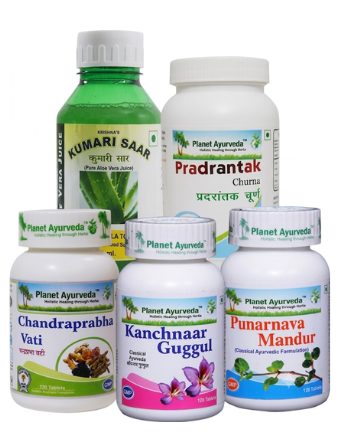

1. Chandraprabha Vati
Chandraprabha Vati is a classical Ayurvedic polyherbal-mineral formulation containing ingredients such as Guggul (Commiphora mukul), Shilajit, Haridra (Curcuma longa), Guduchi (Tinospora cordifolia), Ela (Elettaria cardamomum) and other traditional ingredients. In Ayurveda, it is traditionally described for supporting the balance of Kapha and maintaining healthy metabolic and urinary functions. For women with PCOS, its traditional rationale may relate to metabolic balance and overall reproductive wellness. Several constituent herbs have been studied for their antioxidant and metabolic properties.
Dosage: 2 tablets twice daily with warm water, or as directed by an Ayurvedic physician.
2. Pradrantak Churna
Pradrantak Churna is a traditional Ayurvedic herbal powder prepared with Lodhra (Symplocos racemosa), Ashoka (Saraca asoca), Udumbara (Ficus racemosa) and Arjuna (Terminalia arjuna). These herbs have traditionally been used in Ayurveda to support female reproductive health and maintain healthy menstrual function. In the context of PCOS, the formulation may be considered as part of an overall Ayurvedic approach focused on menstrual wellness and balanced reproductive function. Ashoka and Lodhra contain various phytoconstituents that have been investigated for their antioxidant and reproductive-health-related properties
Dosage: 1 teaspoon twice daily with warm water, or as directed by an Ayurvedic physician.
3. Kanchnaar Guggul
Kanchnaar Guggul is a classical Ayurvedic formulation containing Kachnar bark (Bauhinia variegata), Amalaki (Phyllanthus emblica), Haritaki (Terminalia chebula), Bibhitaki (Terminalia bellirica) and various other herbs. Traditionally, Kachnar and Guggul-based preparations are used in Ayurveda for supporting healthy tissue metabolism and maintaining balanced Kapha. In PCOS, this traditional perspective may be relevant to women experiencing metabolic and menstrual concerns. Some constituent herbs provide polyphenols and other bioactive compounds with antioxidant activity.
Dosage: 2 tablets twice daily with warm water, or as directed by an Ayurvedic physician.
4. Punarnava Mandur
Punarnava Mandur is a classical Ayurvedic formulation traditionally used to support healthy blood formation and conditions associated with low haemoglobin, as well as maintaining normal liver and spleen function. Its important ingredients include Punarnava (Boerhavia diffusa), Triphala, Trikatu and Mandura Bhasma. From an Ayurvedic perspective, it is primarily associated with balancing Kapha and Pitta and supporting proper functioning of the digestive and circulatory systems. In women with PCOS, nutritional and metabolic health are important components of comprehensive care, particularly when menstrual bleeding or dietary factors contribute to iron deficiency.
Dosage: 2 tablets twice daily after meals with plain water, or as directed by an Ayurvedic physician.
5. Kumari Saar
Kumari Saar is a traditional preparation derived from Ghrit Kumari, commonly identified as Aloe (Aloe vera). Aloe contains naturally occurring compounds including polysaccharides, phenolic constituents and other phytochemicals that have been investigated for antioxidant and metabolic activities. In Ayurveda, Kumari is traditionally associated with supporting Pitta and Vata balance and maintaining healthy female reproductive functions. Within an Ayurvedic approach to PCOS, it may be used as part of a broader regimen addressing digestion, metabolism and menstrual wellness. Although preliminary research has explored Aloe vera in relation to metabolic and reproductive parameters, stronger human clinical evidence is required before making specific claims regarding ovarian cyst reduction or normalization of estrogen and progesterone.
Dose: 2 teaspoons twice daily after meals with plain water, or as directed by an Ayurvedic physician.
CONCLUSION
In a nut shell it can be concluded PCOD is a multifactorial hormonal and metabolic disorder that can affect menstruation, ovulation, fertility, and overall well-being. Ayurveda works on correcting Dosha imbalance, improving Agni (digestive fire ), and supporting healthy Artava (egg formation ). Therefore, management focuses not only on menstrual symptoms but also on improving digestion, metabolism, lifestyle, and reproductive health. A balanced diet, regular physical activity, adequate sleep, stress management, and appropriately selected Ayurvedic medicines and therapies may support overall health. An individualized approach based on Prakriti, Dosha involvement, Agni, and clinical presentation can help provide a more holistic framework for women living with PCOS.


Dr. Vikram Chauhan
Latest posts by Dr. Vikram Chauhan (see all)
- Banyan Tree: Medicinal Benefits, Uses & Importance - October 9, 2026
- PCOS Treatment in Ayurveda: Causes, Symptoms & Management - October 9, 2026
- MIDAS Score for Migraine: Symptoms, Treatment & Ayurveda - October 9, 2026
- Estrogen Detox: Ayurvedic Herbs, Diet & Natural Tips - October 9, 2026
- PCOD: Causes, Symptoms, Diagnosis & Ayurvedic Management - October 9, 2026