


How to Manage Mucoepidermoid Carcinoma Through Ayurveda Naturally
Abstract
Mucoepidermoid carcinoma (MEC) is the most common malignant tumor of the salivary glands, characterized by a heterogeneous mixture of mucous, epidermoid, and intermediate cells. It exhibits a wide biological spectrum ranging from low-grade indolent lesions to high-grade aggressive malignancies with metastatic potential. Although it most frequently arises in the parotid gland, MEC can also develop in minor salivary glands, lungs, thyroid, and other organs. Early diagnosis, accurate histological grading, and appropriate multidisciplinary management play a crucial role in determining prognosis. This article provides a comprehensive overview of mucoepidermoid carcinoma from modern medical and Ayurvedic perspectives.
Introduction
Mucoepidermoid carcinoma is a malignant epithelial neoplasm primarily affecting salivary gland tissue. First described in the mid-20th century, it accounts for a significant proportion of both major and minor salivary gland malignancies. The tumor is defined histologically by varying proportions of mucus-secreting cells, squamous (epidermoid) cells, and intermediate cells, which together determine its grade and clinical behavior. MEC affects individuals across a broad age range, including children and young adults, making it unique among salivary gland cancers. The clinical course can vary from slow-growing, painless masses to rapidly enlarging, invasive tumors associated with nerve involvement and distant spread.
Causes
The exact etiology of mucoepidermoid carcinoma remains incompletely understood; however, several contributing factors have been identified:
- Genetic alterations: A recurrent chromosomal translocation t(11;19)(q21;p13), resulting in the CRTC1–MAML2 fusion gene, is strongly associated with low- and intermediate-grade MEC and is considered a favorable prognostic marker.
- Ionizing radiation: Prior exposure to therapeutic or environmental radiation increases the risk of salivary gland malignancies, including MEC.
- Environmental and occupational factors: Exposure to industrial chemicals, heavy metals, and pollutants may contribute to carcinogenesis.
- Age and developmental susceptibility: MEC is one of the most common malignant salivary gland tumors in children, suggesting developmental or genetic vulnerability.
- Chronic inflammation: Long-standing salivary gland irritation or inflammation may act as a promoting factor.
Signs and Symptoms
Clinical presentation depends on the tumor’s location, size, and histological grade:- Painless, slow-growing mass in the parotid or submandibular region (common in low-grade tumors)
- Rapidly enlarging swelling with firm or fixed consistency (often seen in high-grade MEC)
- Pain or tenderness, especially if adjacent tissues are involved
- Facial nerve weakness or paralysis, particularly in parotid gland tumors
- Ulceration or non-healing lesions in minor salivary gland MEC (palate, buccal mucosa)
- Dysphagia, hoarseness, or airway symptoms when tumors arise in the oropharynx or larynx
- Cervical lymphadenopathy in advanced or high-grade cases
Investigation
Accurate diagnosis and grading are essential for management planning:
- Clinical examination: Assessment of tumor size, fixation, nerve involvement, and lymph nodes
- Imaging studies
- Ultrasound for initial evaluation of salivary gland masses
- CT scan to assess bone involvement and regional spread
- MRI for soft tissue delineation and perineural invasion
- Fine-needle aspiration cytology (FNAC): Useful for preliminary diagnosis, though grading may be limited
- Core biopsy or excisional biopsy: Provides definitive histopathological diagnosis
- Histological grading: Tumors are classified as low, intermediate, or high grade based on cellular atypia, cystic component, mitotic activity, and necrosis
- Immunohistochemistry and molecular testing: Detection of MAML2 gene rearrangement aids prognostication
Management
Treatment depends on tumor grade, stage, and anatomical location:
- Surgical excision:
- Wide local excision with clear margins is the cornerstone of treatment
- Superficial or total parotidectomy may be required, with facial nerve preservation when feasible
- Neck dissection: Indicated in high-grade tumors or clinically positive lymph nodes
- Radiation therapy:
- Adjuvant radiotherapy is recommended for high-grade tumors, positive margins, perineural invasion, or nodal disease
- Chemotherapy:
- Limited role; considered in unresectable, recurrent, or metastatic disease
- Targeted and molecular therapies:
- Ongoing research focuses on molecular pathways associated with MEC, especially in advanced cases
- Long-term follow-up:
- Essential due to the risk of late recurrence, particularly in intermediate- and high-grade tumors
Ayurvedic Aspect and Management
From an Ayurvedic perspective, mucoepidermoid carcinoma can be correlated with mamsa pradoshaja vikaras namely Arbuda (malignant tumor) arising due to deep-seated Tridosha vitiation, predominantly Kapha and Pitta, along with involvement of Mamsa Dhatu (muscle tissue) and Rakta Dhatu (blood tissue). Impaired Agni (metabolic fire) and accumulation of Ama (toxic metabolites) play a central role in the pathogenesis.
विद्यान्मांसाश्रयान्,…(Charak Sutra 28/13-15)
The vitiation of Mamsa Dhatu leads to the development of several disorders, including Adhimamsa (granuloma), Arbuda (myoma), Kila (piles), Galashaluka (uvulitis), Galashundika (tonsillitis), Putimamsa (gangrene), Alaji (boils), Ganda (goiter), Gandamala (cervical lymphadenitis), and Upajihvika (inflammation of the epiglottis).
- Dosha Shamana: Balancing aggravated Kapha and Pitta to reduce abnormal tissue proliferation
- Agni Deepana and Ama Pachana: Enhancing digestion and metabolism to prevent further pathological accumulation
- Rakta Shodhana: Purification of blood to inhibit tumor progression
- Lekhana and Granthi-Hara Chikitsa: Therapies aimed at reducing abnormal growths
Commonly Used Ayurvedic Herbs and Formulations
- Curcuma longa (Haridra): Anti-inflammatory and anti-proliferative properties
- Withania somnifera (Ashwagandha): Immunomodulatory and adaptogenic effects
- Tinospora cordifolia (Guduchi): Enhances immunity and detoxification
- Rubia cordifolia (Manjistha): Rakta shodhaka and anti-neoplastic potential
- Classical formulations: Kanchanar Guggulu, Kaishore Guggulu, and specific Rasayana therapies.
Herbal Remedies by Planet Ayurveda for Mucoepidermoid Carcinoma
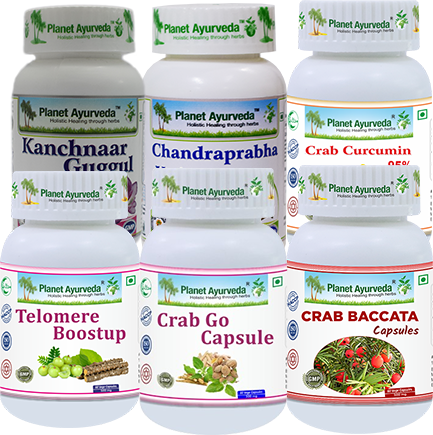

Planet Ayurveda is a reputed Ayurvedic healthcare brand committed to delivering natural health solutions through authentic herbal formulations. Rooted in classical Ayurvedic principles, the company offers a wide range of plant-based products developed with careful attention to quality and purity. Planet Ayurveda focuses on holistic wellness by addressing health concerns at their root while maintaining traditional preparation methods. By combining ancient Ayurvedic knowledge with modern quality standards, the brand provides reliable herbal support for overall health and long-term well-being. Planet Ayurveda is pleased to present its list of products for the management of Mucoepidermoid Carcinoma.
- Kanchnaar Guggul
- Crab Baccata Capsules
- Crab Go Capsules
- Chandraprabha Vati
- Telomere Boostup
- Crab Curcumin 95%
Product Description
1. Kanchnaar Guggul
Kanchnaar Guggul is a classical ayurvedic formulation that helps in checking unwanted cell growth. It primarily pacifies aggravated Kapha and Pitta Dosha, which are responsible for abnormal glandular proliferation seen in salivary gland tumors. Kanchanar (Bauhinia variegata) exhibits lekhana (scraping) and granthi-hara (anticystic) properties that help reduce abnormal tissue growth, while Guggulu (Commiphora mukul) enhances metabolic activity, improves lymphatic drainage, and helps clear Ama (toxic metabolites) accumulated due to impaired Agni (digestion). Its anti-inflammatory, antioxidant, and immunomodulatory actions support control of chronic inflammation and oxidative stress, both of which contribute to tumor progression. Additionally, Kanchnaar Guggul aids in Rakta Shodhana, supports lymph node involvement often seen in advanced cases, and improves tissue metabolism, making it useful as an addition, slowing abnormal growth tendencies, and enhancing overall quality of life.
Dosage : Two tablets twice a day.
2. Crab Baccata Capsules
Crab Baccata Capsules are a product of Planet Ayurveda help in the management of Mucoepidermoid Carcinoma as a supportive Ayurvedic formulation due to their potent anti-proliferative, cytotoxic, and immune-modulating properties. The formulation contains Taxus baccata (source of taxane-like compounds), which is recognized for its ability to inhibit abnormal and uncontrolled cell division. From an Ayurvedic perspective, it acts on Arbuda and Mamsa-Rakta Dushti, helping to control excessive tissue growth, reduce tumor aggressiveness, and limit further cellular mutation.. Additionally, they support the body during conventional cancer therapies by enhancing Ojas (vital immunity), improving cellular resistance, and aiding recovery, making them a valuable product in the management of Mucoepidermoid carcinoma.
Dosage -One capsule twice a day.
3. Crab Go Capsule
Crab Go Capsules are a product of Planet Ayurveda and are composed of potent Ayurvedic herbs that target abnormal tissue growth, inflammation, and immune modulation. The primary ingredients include Withania somnifera (Ashwagandha), which exhibits anticancer and cytotoxic properties by inducing apoptosis in malignant cells and reducing oxidative stress; Asparagus racemosus (Shatavari), which strengthens Ojas (immunity) and enhances tissue regeneration; and Curcuma longa (Haridra), known for its anti-inflammatory, antioxidant, and anti-proliferative effects that inhibit tumor progression. Together with other supportive herbs in the formulation, Crab Go Capsules help balance Kapha and Pitta doshas, detoxify Ama (metabolic toxins), purify Rakta (blood), and create an internal environment unfavorable for tumor growth. Hence the capsules provide adjunctive support by enhancing immunity, controlling inflammation, and promoting systemic resilience, thereby improving overall quality of life in patients with Mucoepidermoid Carcinoma.
Dosage – Two capsules twice a day.
4. Chandraprabha Vati
Chandraprabha Vati is a classical ayurvedic medicine and promotes systemic detoxification, reduces inflammation, and enhances overall metabolic and immune resilience. This classic Ayurvedic formulation contains a blend of herbs and mineral preparations that work collectively to purify blood, eliminate metabolic toxins (Ama), and balance all three doshas (Vata, Pitta, Kapha). Many of its ingredients such as Guduchi (Tinospora cordifolia), Haridra (Curcuma longa), Musta (Cyperus rotundus), Vacha (Acorus calamus), Shilajit(Asphaltum) and others exhibit anti‑inflammatory, antioxidant, and immunomodulatory effects that can help reduce oxidative stress and support healthy tissue metabolism. By improving agni (digestive/metabolic fire) and aiding toxin elimination, Chandraprabha Vati supports Rakta Shodhana (blood purification), and enhances the body’s natural defense mechanisms.With these actions, it is a valuable addition in integrative care, improving patient strength, reducing inflammation, and supporting quality of life in Mucoepidermoid Carcinoma.
Dosage -Two tablets twice a day.
5. Telomere Boostup
Telomere Boostup Capsules are a product of Planet Ayurveda. This polyherbal formulation contains standardized extracts of Withania somnifera (Ashwagandha), Vitis vinifera (grape seed), Emblica officinalis (Amla), Moringa oleifera, and Tinospora cordifolia (Giloy), which together provide potent antioxidant, adaptogenic, and immune‑supportive actions that help protect cells from oxidative stress and support systemic resilience against pathological processes. The ingredients in Telomere Boostup help eliminate Ama (metabolic toxins) and prevent the formation of abnormal growths. Additionally, these herbs have rejuvenative (Rasayana) properties that nourish bodily tissues (dhatus), strengthen Agni (metabolic fire), and enhance immunity. Its antioxidant, detoxifying, and systemic support properties can be useful as an adjunct in an integrative management plan for patients with mucoepidermoid carcinoma.
Dosage – One capsule twice a day.
6. Crab Curcumin 95%
Planet Ayurveda’s Crab Curcumin 95% Capsules composed of concentrated extract of curcumin, the active compound derived from Curcuma longa (turmeric), which exhibits strong anti‑cancer, antioxidant, and anti‑inflammatory properties. Curcumin helps to modify cancer cell signaling pathways, inhibit the cell cycle of malignant cells, and induce apoptosis (programmed cell death), thereby reducing abnormal cell growth associated with tumors. It also neutralizes free radicals and reduces the production of oxidative toxins, which can contribute to tumor progression and tissue damage, while supporting detoxification processes within the body. Additionally, curcumin’s anti‑inflammatory effects help reduce chronic inflammation that often accompanies cancer development, supporting overall cellular health and immune function. Therefore, these capsules are of great help in the management of Mucoepodermoid Carcinoma.
Dosage : One capsule twice a day.
Conclusion
Mucoepidermoid carcinoma (MEC) is a complex malignant tumor of the salivary glands with a variable clinical course, ranging from indolent low-grade lesions to aggressive high-grade malignancies with metastatic potential. Early diagnosis, accurate histological grading, and appropriate multidisciplinary management remain critical for improving patient outcomes. Integrative approaches that combine conventional oncological treatments with supportive Ayurvedic care can provide holistic benefits by addressing the underlying Tridosha vitiation, Ama (endotoxins) accumulation, and Dhatu imbalance associated with tumor progression. Above mentioned ayurvedic formulations improve overall quality of life, help control pathological growth tendencies, and provide a complementary approach in the long-term management of Mucoepidermoid carcinoma.


Dr. Vikram Chauhan
Latest posts by Dr. Vikram Chauhan (see all)
- Management of Olfactory neuroblastoma (ONB) in Ayurveda - September 28, 2026
- What is Aroma Therapy? – How is it an important part of Indian and different cultures since long? - September 18, 2026
- Cow Dung & Wood Heat vs Room Heaters – Health Benefits & Risks - September 17, 2026
- Let’s bust some myths about Infertility and Pregnancy? - September 15, 2026
- Zero Volt Therapy – Benefits, Uses & Holistic Wellness Approach - September 10, 2026