


Chronic Kidney Disease (CKD): Symptoms & Ayurvedic Management
Abstract
Chronic kidney disease is a progressive condition characterized by the kidneys gradually losing their ability to filter waste and maintain the body’s fluid and mineral balance. It may develop silently, with symptoms appearing only when kidney function is significantly affected. Diabetes, hypertension, obesity, and unhealthy lifestyle habits are common contributing factors. Early diagnosis and timely management can help slow disease progression and protect kidney function. From an Ayurvedic perspective, CKD can be understood through disturbances involving Mutravaha Srotas, Dosha imbalance, and impaired Agni. This article explores the causes, symptoms, stages, diagnosis, and Ayurvedic management of CKD.

Introduction
Our kidneys work quietly every day to filter waste, balance fluids, regulate electrolytes, and support several important functions of the body. Chronic Kidney Disease (CKD) occurs when kidney function remains abnormal for a prolonged period and gradually reduces the kidneys’ ability to filter waste from blood. No symptoms are seen in the early stages Diabetes, high blood pressure, obesity, recurrent kidney problems, and certain medications or diseases can increase the risk. Early detection through blood and urine tests, along with medical care and lifestyle changes, is important to slow progression and reduce complications.
Definition
Chronic Kidney Disease is a progressive condition when kidneys become damaged, or their filtering capacity decreases over time. A commonly used marker is the estimated glomerular filtration rate (eGFR), which reflects how effectively the kidneys filter blood. CKD is generally considered chronic when kidney abnormalities persist for at least 3 months or more.
Causes of CKD
- Diabetes mellitus
- Hypertension
- Glomerular disease
- Polycystic kidney disease
- Recurrent urinary tract infection
- Sepsis
- Renal stone
- Obesity
- Nephrotoxic medication for a long time
- Autoimmune disease
Signs and Symptoms
- Foamy urination (proteinuria)
- Pitting edema and swelling around the eyes
- Fatigue and weakness
- Hypertension
- Decreased urine output
- Decrease appetite
- Muscle cramps
- Dry skin
- Difficulty breathing if fluid overload
- Nausea and vomiting
CKD Stages
CKD is commonly classified according to eGFR (estimated glomerular filtration rate):
- Stage 1: eGFR ≥90 with evidence of kidney damage like proteinuria
- Stage 2: eGFR 60–89 with mild kidney damage
- Stage 3a: eGFR 45–59 with mild to moderate kidney damage
- Stage 3b: eGFR 30–44 with moderate to severe kidney damage
- Stage 4: eGFR 15–29 with severe kidney damage
- Stage 5: eGFR <15, kidney failure or ESRD (end stage of renal disease)
Diagnostic Approach
Early investigation is important because CKD can remain silent for years.
- Serum creatinine
- eGFR
- Urine routine examination
- Urine albumin-to-creatinine ratio (ACR)
- Blood urea
- Electrolytes
- Blood pressure measurement
- Complete Blood Count (CBC)
- Blood glucose and HbA1c
- Lipid profile
- Ultrasound of the kidneys and urinary tract, when indicated
- Kidney biopsy
If eGFR is less than 60 and ACR is more than 30 for at least 3 months, it may be a sign of CKD
Ayurvedic Perspective of CKD
From an Ayurvedic perspective, CKD can be understood through disturbances involving Mutravaha Srotas, Dosha imbalance, and impaired Agni. According to Ayurveda, improper Ahara (diet) and Vihara (lifestyle) may disturb Agni and contribute to the formation of Ama. Depending on the individuals condition, Dosha imbalance and impairment of the urinary pathways may affect normal Mutra (urine) formation and elimination.
Ayurvedic management
Ayurveda focuses on the individual’s Prakriti, Vikriti, Agni, Dosha, Dhatu, Mutra, diet, lifestyle, and associated symptoms.
1. Nidana Parivarjana
The first principle is avoiding factors that may cause the condition, such as:
- Excessive salt intake
- Highly processed foods
- Excessive sugar intake
- Smoking and tobacco
- Uncontrolled blood pressure
- Poorly controlled diabetes
- Use of medicines or herbal products that may affect kidney function
2. Ahara (Diet)
Diet should be planned according to kidney function and individual nutritional requirements.
- Fresh foods are generally preferable
- Low-sodium diet (use less salt)
- Low potassium diet (no coconut water, no banana)
- Decrease fluid take
- No citrus fruits
- Eat apples, papaya, guava
- Low-fat milk
- Avoid juice and soft drinks
- Take herbal tea as part of your routine (Planet Ayurveda)
3. Vihara (Lifestyle)
A healthy routine can support overall health:
- Maintain a healthy body weight.
- Stay physically active as per your capacity.
- Get adequate sleep.
- Manage stress.
- Avoid smoking and tobacco.
- Monitor blood pressure and blood glucose regularly.
4. Ayurvedic Herbal Support
Ayurvedic herbs such as Punarnava (Boerhavia diffusa), Varuna (Crataeva nurvala), Gokshura (Tribulus terrestris), and Guduchi (Tinospora cordifolia) are used in different Ayurvedic formulations for urinary and systemic support.
Herbal remedies for chronic kidney disease by Planet Ayurveda
Planet Ayurveda is an Ayurvedic wellness brand offering herbal formulations inspired by classical Ayurvedic principles, focusing on natural ingredients, traditional knowledge, quality, and holistic approaches to overall health and wellness. Planet ayurveda offers the best combination of effective herbal remedies, such as Revive Kidney Pack for chronic kidney disease.
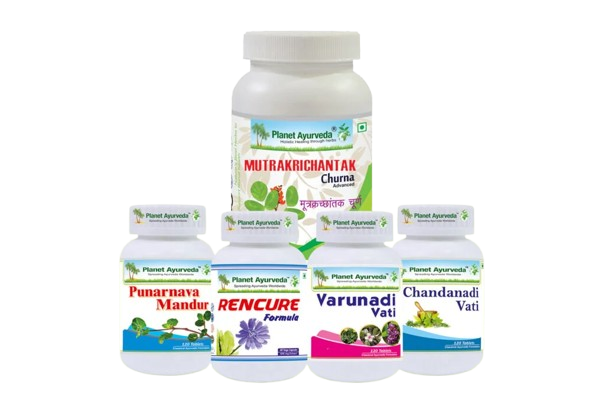
REVIVE KIDNEYS PACK

Product Description
1. Varunadi Vati- Varunadi Vati is used for urinary and renal system support. It is prepared using Varun (Crataeva nurvala), Punarnava (Boerhaavia diffusa), Shuddha Guggulu (Commiphora mukul), Gokshur (Tribulus terrestris). Varun, Punarnava, and Gokshur are traditionally associated with Mutravaha Srotas support. The formulation is used for urinary discomfort, altered urination, or other urinary complaints.
Dosage: Take 2 tablets three times a day with warm water after meals.
2. Mutrakrichantak churna– Mutrakrichantak churna uses herbs aimed at supporting urinary function and kidney health. Varun (Crataeva nurvala) works to support the urinary tract and Mutravaha Srotas. Bhumi Amalaki (Phyllanthus niruri) is valued for its supportive role in urinary and metabolic health. kalmegh (andrographis paniculata). Gokshur (Tribulus terrestris). used to support healthy urinary elimination.
Dosage – Take 1 teaspoonful twice a day with warm water.
3. Renucure formula- Renucure formula contains a combination of herbs used to support kidney and urinary health prepared using Punarnava (Boerhaavia diffusa), Varun (Crataeva nurvala), Gokshur (Tribulus terrestris), Kaasni (Cichorium intybus), Gokshur (Tribulus terrestris), Palash (Butea monosperma). This combination is used to support Mutravaha Srotas, healthy urinary function, and overall metabolic balance.
Dosage – Take 2 capsules twice a day with warm water after meals
4. Punarnava mandur- Punarnava Mandur is a classical Ayurvedic formulation containing Punarnava, digestive herbs, and Mandura Bhasma. It is traditionally used in conditions involving Pandu (anemia), swelling, and impaired metabolism, depending on the Ayurvedic diagnosis. Punarnava (Boerhaavia diffusa), Maricha (Piper nigrum), Haritaki (Terminalia chebula), Mandura Bhasma. Punarnava is traditionally valued for its role in Shotha (swelling) and urinary support, while herbs such as Pippali, Shunthi, and Maricha are traditionally used to support Agni (digestion and metabolism).
Dosage – Take 2 tablets three times a day with warm water after meals
5. Chandanadi vati- Chandanadi vati is a classical Ayurvedic formulation traditionally used for urinary discomfort and conditions associated with burning sensation and Pitta aggravation prepared using Shweta Chandan (Santalum album) etc. Chandanadi Vati is traditionally used for Mutradaha (burning micturition) and other urinary complaints. Its ingredients have cooling, soothing, and supportive properties.
Dosage – Take 2 tablets twice a day with warm water after meals.
Conclusion
Chronic Kidney Disease is often called a silent condition because kidney damage can progress before noticeable symptoms appear. Early detection, control of diabetes and blood pressure, appropriate diet, healthy lifestyle habits, and regular medical monitoring can help protect remaining kidney function. Ayurveda provides a holistic framework involving Mutravaha Srotas, Dosha, Agni, Ahara, and Vihara, which may be incorporated as supportive care. However, CKD requires careful medical supervision, especially in moderate to advanced stages. A balanced approach combining evidence-based nephrology with appropriately selected Ayurvedic care can help support overall health while avoiding unsafe or unmonitored treatments.


Dr. Vikram Chauhan
Latest posts by Dr. Vikram Chauhan (see all)
- Chronic Kidney Disease (CKD): Symptoms & Ayurvedic Management - October 14, 2026
- Tonsillitis: Symptoms, Treatment & Ayurvedic Remedies - October 14, 2026
- Banyan Tree: Medicinal Benefits, Uses & Importance - October 9, 2026
- PCOS Treatment in Ayurveda: Causes, Symptoms & Management - October 9, 2026
- MIDAS Score for Migraine: Symptoms, Treatment & Ayurveda - October 9, 2026