


Immune Thrombocytopenia (ITP): Causes, Symptoms, Diagnosis & Treatment
ABSTRACT
Immune thrombocytopenia (ITP) is an autoimmune condition in which body’s immune system destroys platelets which leads to a low platelet count and increased risk of bleeding. It affects approximately 2–4 adults per 100,000 people every year and it can occur at any age. In children, ITP often develops after a viral infection, while in adults it may become persistent or chronic. Common risk factors include viral infections, autoimmune diseases, certain medicines, HIV, hepatitis C, and Helicobacter pylori infection. However, in many patients, no specific cause is identified, and it is called primary ITP. The severity varies from no symptoms to easy bruising, nose and gum bleeding, and, rarely, serious bleeding.
INTRODUCTION
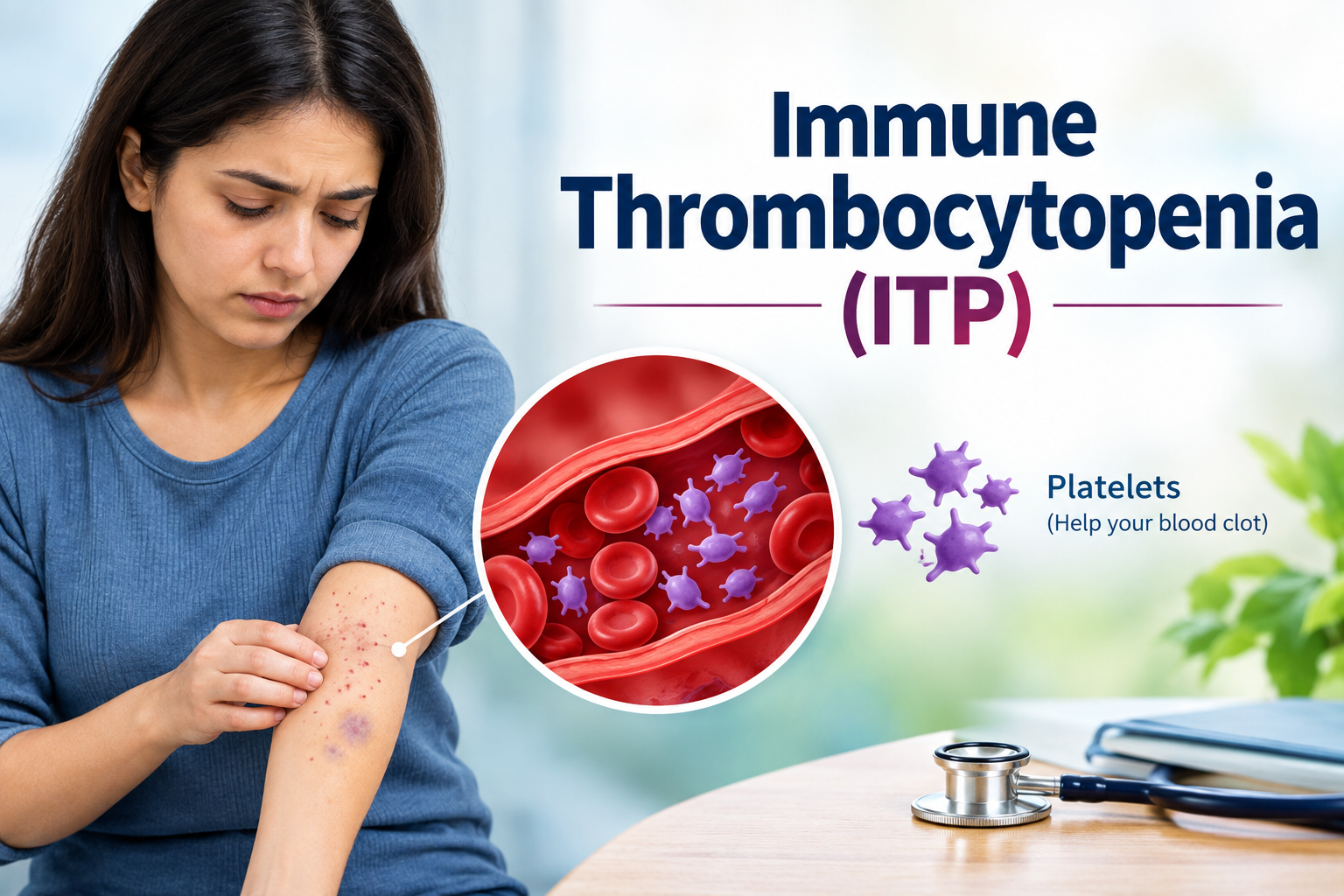
Immune thrombocytopenia (ITP) is an acquired autoimmune disorder characterized by a low platelet count and it is caused mainly by immune-mediated platelet destruction . In this our immune system mistakenly recognizes platelets as foreign and destroys them, resulting in a persistently reduced platelet count. The condition is usually characterized by isolated thrombocytopenia, generally with a platelet count below 100 × 10⁹/L, without another clear cause of thrombocytopenia.
CAUSES OF ITP
ITP is primarily caused by an abnormal immune response against the body’s own platelets. The immune system produces antibodies and activates our immune cells that recognize platelets as abnormal and destroys them .
- Primary ITP- In this, there is no specific underlying disease or trigger. It is considered an autoimmune disorder in which the immune system attacks on platelets.
- Secondary ITP- Secondary ITP occurs when thrombocytopenia develops in association with another condition or exposure.
Common causes include:
- Viral infections: HIV, hepatitis C, hepatitis B, Epstein–Barr virus (EBV), cytomegalovirus (CMV), and other viral infections can trigger an immune response against platelets.
- Helicobacter pylori infection: In some patients, H. pylori infection is associated with ITP .
- Autoimmune diseases: Conditions like systemic lupus erythematosus (SLE), antiphospholipid syndrome, and autoimmune thyroid disorders may be associated with secondary ITP.
- Medications: Some medicines can cause immune-mediated platelet destruction. Examples include quinine, sulfonamides, vancomycin, heparin, and few other drugs.
- Vaccination or immune stimulation: ITP can rarely develop after vaccination or other immune stimulation, although this is uncommon and does not mean vaccination is a common cause of ITP.
- Pregnancy: ITP can occur during pregnancy and may represent pre-existing or newly diagnosed immune thrombocytopenia. It must be differentiated from other pregnancy-related causes of low platelets, like pre-eclampsia and HELLP syndrome.
PATHOGENESIS
Nidana sevana (causative factors)
↓
Agni mandya (impaired digestion and metabolism)
↓
Ama utpatti (formation of metabolic waste/toxic material)
↓
Tridosha prakopa, mainly Pitta (aggravation of the doshas, particularly Pitta dosha)
↓
Rakta dushti (abnormality or disturbance of blood tissue)
↓
Raktavaha srotas dushti (disturbance of the channels responsible for blood circulation and transport)
↓
Pitta-Rakta dushti (interaction of aggravated Pitta with Rakta)
↓
Rakta dhatu daurbalya (functional weakness of blood tissue)
↓
Rakta srava tendency (increased tendency for bleeding)
↓
Petechiae, purpura, epistaxis and gum bleeding
Key Pathology: Autoimmune destruction of platelets + impaired production of platelets → thrombocytopenia (platelet count below 150,000/µL )→ leads bleeding tendency.
CLINICAL FEATURES
ITP mainly causes bleeding because the platelet count is low. Some patients may have no symptoms, while others can develop mild to severe bleeding.
Asymptomatic Thrombocytopenia
- Many patients are asymptomatic .
- Low platelet count may be discovered accidentally during a routine CBC (complete blood count).
Petechiae
- Petechiae are small , pinpoint, reddish-purplish spots on the skin.
- It is mostly seen on the lower legs, ankles and other dependent areas.
- Even on applying pressure , they do not disappear.
Purpura
- Purpura are purple, red or reddish-brown patches under the skin .
- They may occur spontaneously or even after minor trauma.
Easy Bruising
- Patients may develop ecchymosis (large bruises) after minimal trauma.
- Bruises appears mainly on the arms, legs or other parts of the body.
Epistaxis
- Bleeding from nose may occur spontaneously or after minor irritation.
- It can be recurrent and sometimes it is difficult to control when platelet count are very low.
Gum Bleeding
- Bleeding from the gums may occur, particularly during brushing teeth or eating.
- Persistent oral bleeding (constant oral bleeding )may be a sign of significant thrombocytopenia.
Menorrhagia
- Females may experience heavy or prolonged menstrual bleeding.
Oral Bleeding
- Blood-filled blisters may develop inside the mouth.
Hematuria
- Some patients may develop blood in the urine (hematuria).
- It is less common .
Gastrointestinal Bleeding
- Bleeding may occur from the GIT tract (gastrointestinal tract)
- Patients may present with black colored stools (melena) or blood in the stool .
Intracranial Hemorrhage
- This is a medical emergency.
- Intracranial hemorrhage (bleeding inside the skull) is rare but is the most serious complication of ITP.
- Symptoms may include severe headache, vomiting, altered consciousness, weakness, seizures .
Pallor and Fatigue
- Repeated or heavy bleeding may result in anemia.
- Patients may develop pallor, weakness, fatigue, dizziness and shortness of breath due to blood loss.
DIAGNOSIS
ITP is mainly diagnosed by finding a low platelet count and ruling out other causes of low platelets. There is no single test to confirm ITP.
CBC – Complete Blood Count- This is the main initial test.
- Normal platelets: 150,000–450,000/µL
- Thrombocytopenia: below 150,000/µL
- In ITP, platelet count is often below 100,000/µL.
Peripheral Blood Smear- A small amount of blood is examined under a microscope.
In ITP:
- Platelets are reduced.
- Some platelets may appear larger in size than normal.
- Red and white blood cells morphology are usually normal.
It also helps rule out leukemia and platelet clumping.
HIV and Hepatitis Tests- HIV , HBV (hepatitis B) and hepatitis C (HCV) may cause low platelets.
Liver Function Tests (LFT)- Helps to rule out liver disease, which can also cause low platelets.
Kidney Function Tests (KFT)- Helps to rule out any kidney disease
PT/INR and aPTT- These are blood-clotting tests.
In uncomplicated ITP:
- PT/INR – usually normal
- aPTT – usually normal
Abnormal results may suggest another bleeding or clotting disorder.
Bone Marrow Test- Bone marrow examination is usually not needed in typical ITP. It is advised if :
- Other blood cells are also abnormal.
- Blood smear is abnormal .
- There are enlarged lymph nodes or spleen.
- The diagnosis is uncertain.
Antiplatelet Antibody Test- This looks for antibodies against platelets. This test is not accurate enough to confirm ITP .
ANA and Other Autoimmune Tests- ANA may be done when an autoimmune disease such as SLE is suspected.
TREATMENT
The treatment of Immune Thrombocytopenia (ITP) depends on the platelet count, bleeding symptoms, age, and overall health. The main aim is to prevent serious bleeding, not necessarily to make the platelet count completely normal.
Observation- If platelet count is reasonably stable and there is no or very mild bleeding, treatment may not be needed immediately.
- Regular CBC and platelet monitoring is done.
- Avoid unnecessary aspirin and NSAIDs, as they can increase bleeding risk.
Steroids – First-Line Treatment- Common medicines used are :
- Prednisolone/Prednisone
- Dexamethasone
They suppress the immune system’s attack on platelets and help to increase the platelet count.
IVIG- Intravenous immunoglobulin (IVIG) can increase platelet counts quickly. It is mainly used when:
- There is significant bleeding.
- A rapid rise in platelets is needed.
TPO-Receptor Agonists (Thrombopoietin-Receptor Agonists )- These medicines helps to stimulate the bone marrow to produce more platelets. They are commonly used when ITP continues or does not respond adequately to the initial treatment.
Examples:
- Eltrombopag
- Romiplostim
- Avatrombopag
Rituximab- Rituximab is usually given as an intravenous (IV) infusion. A commonly used ITP regimen is – 375 mg/m² IV once weekly for 4 weeks Rituximab reduces the activity of B cells, which are involved in producing antibodies that attack platelets.
Spleenectomy- The spleen is an important site where antibody-coated platelets are destroyed. Removing the spleen (splenectomy) can produce long-term remission in selected patients, but it is generally considered after other treatment options.
Other Medicines-For difficult or treatment-resistant ITP, specialists may use medicines such as:
- Fostamatinib
- Mycophenolate mofetil
- Azathioprine
- Cyclosporine
- Danazol
Treat the Underlying Cause- If ITP is secondary then that condition should also be treated. For example:
- H. pylori → H. pylori eradication
- HIV → appropriate antiviral treatment
- Hepatitis C → antiviral treatment
- Drug-induced ITP → stop the causative medicine under medical supervision
Emergency Treatment- If there is severe or life-threatening bleeding, urgent hospital treatment is required.
AYURVEDIC POINT OF VIEW
From an Ayurvedic perspective, Immune Thrombocytopenia (ITP) can be correlated with tirryak raktapitta for its bleeding manifestations . Its clinical manifestations, particularly bleeding tendency, petechiae and purpura, can be understood through the concepts of Rakta dhatu, Raktavaha srotas and Pitta-Rakta dushti. Rakta dhatu is responsible for nourishment and maintenance of the body, while Raktavaha srotas maintains the circulation and distribution of Rakta. Aggravated Pitta, particularly in association with Rakta, may contribute to bleeding manifestations. Impaired Agni and formation of Ama may be considered as contributing factors in the overall disease process, especially when associated with poor digestion and metabolic imbalance. Therefore, Ayurvedic assessment focuses on Agni, Dosha, Rakta dhatu, Raktavaha srotas, Bala and Ojas, along with the patient’s bleeding symptoms.
Herbs Used Supportively in ITP
Herb |
Botanical Name |
Major Constituents |
Main Action |
Guduchi |
Tinospora cordifolia |
Tinosporin, cordifolioside, diterpenoids |
Immunomodulatory and antioxidant; supports balanced immune function |
Amalaki |
Phyllanthus emblica |
Vitamin C, emblicanin A & B, polyphenols |
Antioxidant; supports tissue health and overall immunity |
Ashwagandha |
Withania somnifera |
Withanolides, sitoindosides |
Adaptogenic and antioxidant; supports strength and recovery |
Yashtimadhu |
Glycyrrhiza glabra |
Glycyrrhizin, liquiritin, flavonoids |
Anti-inflammatory and antioxidant; supports mucosal health |
Punarnava |
Boerhaavia diffusa |
Punarnavine, boeravinones, flavonoids |
Antioxidant and anti-inflammatory; supports normal physiological functions |
Bhumyamalaki |
Phyllanthus niruri |
Phyllanthin, hypophyllanthin, lignans |
Antioxidant and hepatoprotective; supports liver health |
HERBS USED FOR ITP IN PLANET AYURVEDA
Planet Ayurveda is a global Ayurvedic wellness brand dedicated to bringing the wisdom of traditional Ayurveda into modern life. Based in Chandigarh, India, the brand offers a diverse range of herbal formulations prepared using carefully selected Ayurvedic herbs, classical ingredients, and standardized manufacturing practices. With a strong focus on quality, authenticity, purity, and consistency, Planet Ayurveda serves customers across India and worldwide. Its product range covers various aspects of everyday wellness and traditional health care. Along with herbal formulations, Planet Ayurveda provides personalized Ayurvedic consultations, combining classical Ayurvedic principles with individualized guidance. The brand aims to make Ayurveda accessible while maintaining traditional values and modern quality standards, helping individuals incorporate Ayurvedic wellness into their daily routines. Therefore, PLANET AYURVEDA focuses on monitoring platelet counts, assessing bleeding risk, supporting overall health, and addressing possible underlying triggers or associated conditions. In ITP, PLANET AYURVEDA aimed at supporting healthy Rakta dhatu, maintaining digestive and metabolic balance, and addressing associated symptoms through appropriate herbs and classical formulations.
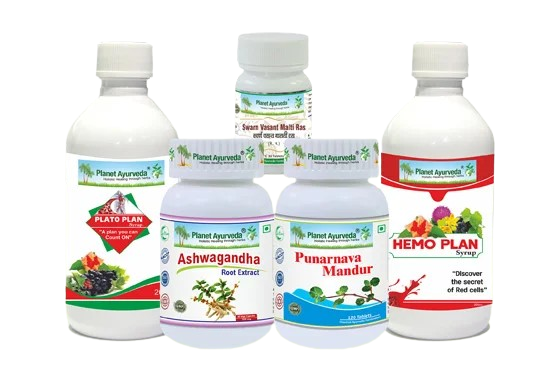
- Plato Plan Syrup – 2 spoons twice daily.
- Ashwagandha Capsules – 1 capsule twice daily.
- Punarnava Mandur – 2 tablets twice daily.
- Hemo Plan Syrup – 2 spoons twice daily.
- Swarn Vasant Malti Ras – 1 tablet daily to be chewed with lukewarm water.
Herbal Remedies for Immune Thrombocytopenia (ITP)

Product description
1. Platoplan Syrup
Platoplan Syrup by Planet Ayurveda combines Carica papaya (Erand Karkati), Tinospora cordifolia (Giloy), Triticum aestivum (Wheat Grass), Withania somnifera (Ashwagandha), Emblica officinalis (Amalaki), Moringa oleifera (Shigru), Leptadenia reticulata (Jeevanti), and Vitis vinifera (Draksha). From an Ayurvedic perspective, the herbs are traditionally used in approaches involving Rasayana, Balya, and Dhatu nourishment. The formulation may be included as part of an individualized supportive wellness regimen, particularly where attention to vitality and nutritional support is appropriate. It is not intended to substitute hematological assessment, platelet monitoring, or conventional care for ITP.
Dosage: 5–10 mL (1–2 teaspoons) twice daily after meals, or according to the advice of an Ayurvedic physician.
2. Ashwagandha Capsules
Ashwagandha Capsules provide an extract of Withania somnifera, a well-known herb in classical Ayurveda. It is traditionally described as a Rasayana and is associated with Bala, nourishment of the Dhatus, and maintenance of Ojas. Ayurvedic use commonly emphasizes strength, vitality, and support in Vata-predominant conditions. Contemporary research has explored various properties of Withania somnifera, including its effects on stress-related responses, antioxidant activity, and immune pathways. These findings should not be interpreted as evidence that Ashwagandha specifically treats ITP. Its inclusion in an Ayurvedic supportive regimen should be determined according to the person’s constitution, digestive capacity, strength, and nutritional requirements.
Dosage: 1 capsule twice daily with plain water after meals, or as recommended by an Ayurvedic physician.
3. Punarnava Mandur
Punarnava Mandur is a traditional Ayurvedic herbo-mineral preparation formulated with Boerhaavia diffusa (Punarnava), Zingiber officinale (Shunti), Piper longum (Pippali), Piper nigrum (Maricha), Emblica officinalis (Amalaki), Terminalia chebula (Haritaki), Piper chaba (Chavya), Curcuma longa (Haridra), Embelia ribes (Vidanga), Plumbago zeylanica (Chitraka), and Mandura Bhasma. Traditionally, this preparation is used in relation to Pandu, digestive support, Agni Deepana, Pachana, and Rakta Dhatu nourishment. It may be selected in an individualized Ayurvedic plan when digestive or nutritional considerations are present. It should not be described as a platelet-increasing medicine or as a treatment for ITP. Since Mandura Bhasma is part of the formulation, appropriate professional guidance is advisable.
Dosage: 1–2 tablets two to three times daily after meals with lukewarm water, or as directed by an Ayurvedic physician.
4. Hemo Plan Syrup
Hemo Plan Syrup by Planet Ayurveda is formulated with Rubia cordifolia (Manjistha), Asparagus racemosus (Shatavari), Sphaeranthus indicus (Gorakhmundi), Withania somnifera (Ashwagandha), Vitis vinifera (Draksha), and Hemidesmus indicus (Sariva). Several of these herbs have long-standing applications in Ayurveda for Rakta Dhatu nourishment, Pitta-oriented care, and general strength and vitality. Manjistha and Sariva are traditionally associated with Rakta Prasadana, whereas Shatavari, Ashwagandha, and Draksha are valued for their nourishing qualities. It can be considered as a complementary Ayurvedic wellness formulation based on individual needs. It should be used alongside appropriate medical supervision and not as a replacement for ITP evaluation or hematological treatment.
Dosage: 5–10 mL (1–2 teaspoons) twice daily after meals, or as advised by an Ayurvedic physician.
5. Swarna Vasant Malti Ras
Swarna Vasant Malti Ras is a classical Ayurvedic herbo-mineral formulation containing Swarna Bhasma, Mukta Bhasma, Shuddha Hingula etc . In traditional Ayurvedic practice, it is regarded as a Rasayana and Balya preparation, with applications centered on maintaining strength, vitality, and tissue nourishment. Swarna and Mukta Bhasma are traditionally incorporated into Rasayana-oriented formulations, while Maricha is recognized for its role in Agni Deepana and Pachana. For individuals with ITP, it should be viewed only as individualized complementary Ayurvedic support and not as an established therapy for increasing platelet counts. Because the formulation contains mineral and processed ingredients, it should be taken only under qualified Ayurvedic supervision.
Dosage:1 tablet once daily, or strictly as prescribed by a qualified Ayurvedic physician.
CONCLUSION
At last, we can say ITP is an autoimmune condition in which the body’s immune system destroys platelets, leading to a low platelet count and increased risk of bleeding. Early diagnosis, regular platelet monitoring, and appropriate medical treatment are important. From an Ayurvedic perspective, the condition can be understood through the concepts of Rakta dhatu, Raktavaha srotas and Pitta-Rakta imbalance. Ayurvedic herbs and supportive measures may help maintain overall health and immune balance, but they should be used carefully along with proper medical care.


Dr. Vikram Chauhan
Latest posts by Dr. Vikram Chauhan (see all)
- Immune Thrombocytopenia (ITP): Causes, Symptoms, Diagnosis & Treatment - September 19, 2026
- Immune Thrombocytopenia (ITP): Causes, Symptoms & Ayurvedic Support - September 18, 2026
- Ulcerative Colitis: Causes, Symptoms & Treatment with Ayurveda - September 17, 2026
- Holistic PCOD Management: Modern Science Meets Ayurvedic Healing - September 16, 2026
- Fatty Liver: Diet & Ayurvedic Management - September 15, 2026