


Prostate Cancer: Symptoms, Treatment & Ayurvedic Support
Abstract
Prostate cancer is a significant health concern among men, and its occurrence generally becomes more common with advancing age. Changes in the prostate may cause urinary problems, such as difficulty in passing urine, altered urine flow or increased urinary frequency. Proper diagnosis and timely medical care are essential for managing the condition. Ayurveda (traditional Indian system of medicine) takes an individualised approach to health by considering the balance of Dosha (functional body principles), Agni (digestive and metabolic activity), Mutravaha Srotas (urinary channels) and Rasayana (rejuvenative and supportive care). These concepts can be used to develop supportive measures according to an individuals health status. Various Ayurvedic formulations, including Kanchnaar Guggul, Prostate Endza, Varunadi Vati, Tumotrim Capsules, Chandraprabha Vati, Vriddhi Vadhika Vati and Crab Arlu Capsules, have traditional applications related to urinary function, metabolism and general tissue support. Their use in prostate cancer should be considered complementary rather than as a replacement for established cancer treatment. A qualified healthcare professional should guide their use, particularly when the patient is undergoing oncology treatment.
Introduction
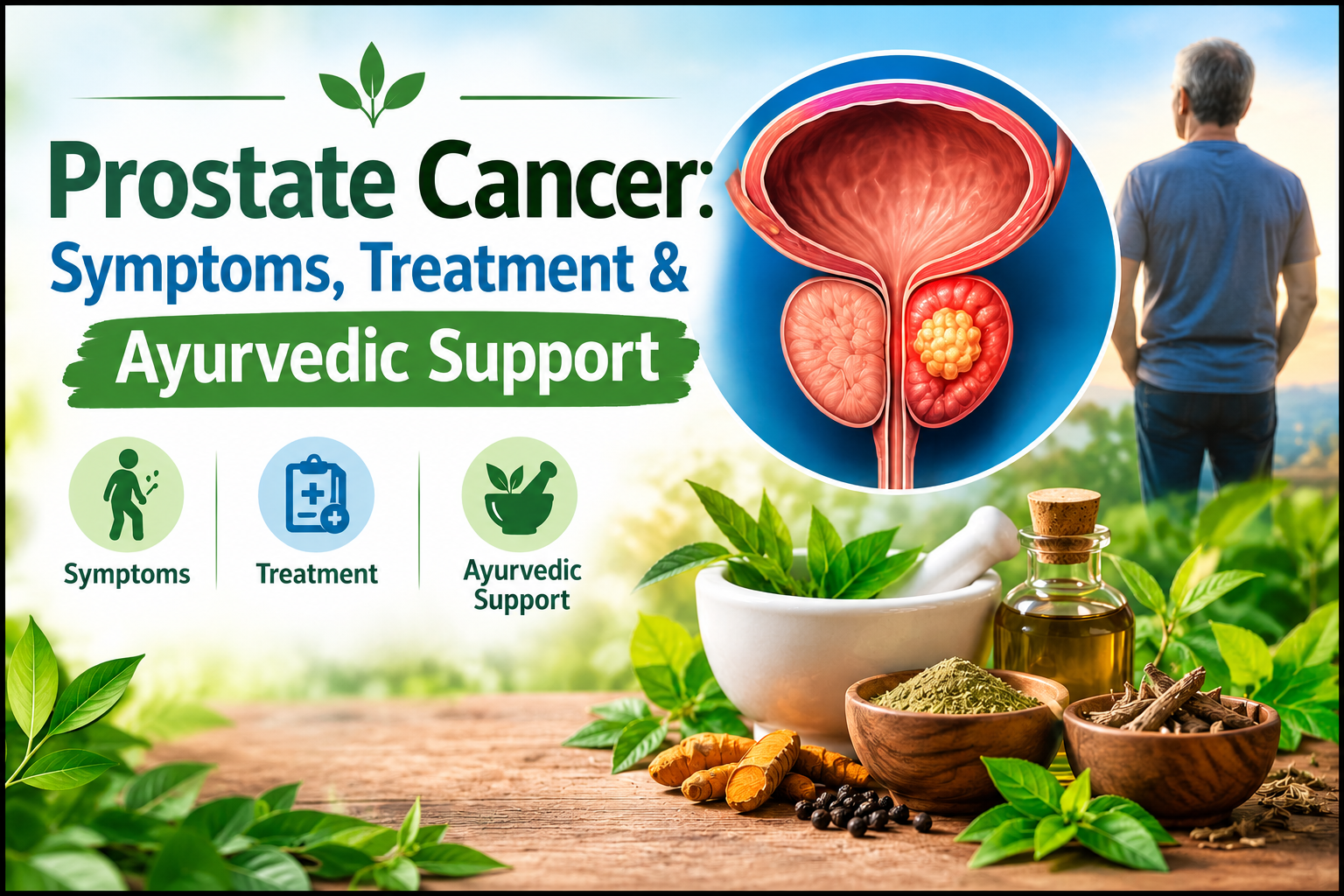
Prostate cancer occurs when abnormal cells begin to grow uncontrollably in the prostate gland. It is more frequently found in older men, although its course can differ from one person to another. Some prostate cancers develop slowly and may remain limited to the gland, while others can grow faster and spread to nearby or distant parts of the body. In the early stages, prostate cancer may not cause clear symptoms. As the condition progresses, some men may experience frequent urination, difficulty starting or maintaining urine flow, a reduced urine stream, or blood in the urine. When the cancer spreads, particularly to the bones, it may cause ongoing pain or other complications. The choice of treatment depends on several factors, including the stage and grade of the cancer, PSA (prostate-specific antigen) levels, general health and the individuals treatment needs. Depending on the situation, management may involve active surveillance, surgery, radiotherapy, hormone-based treatment or other systemic therapies. Ayurveda (traditional Indian system of medicine) may be considered as a complementary approach to support general health and well-being during cancer care. However, Ayurvedic formulations should not be presented as proven treatments or cures for prostate cancer. Some herbs and traditional preparations may also interact with medicines or cancer therapies. Therefore, Ayurvedic care should be discussed with qualified healthcare professionals and used alongside, rather than instead of, appropriate oncology treatment.
Causes and Risk Factors of Prostate Cancer
- Age: The likelihood of prostate cancer increases considerably with advancing age.
- Family history: Men with a close family member who has had prostate cancer may have a higher risk.
- Inherited genetic changes: Alterations in genes involved in DNA repair, such as BRCA1 and BRCA2, can increase susceptibility in some individuals.
- Hormonal factors: Male sex hormones called androgens influence prostate-cell growth and have an important role in prostate cancer development and progression.
- Ethnic and population differences: The occurrence of prostate cancer varies between population groups, although the reasons for these differences are not fully established.
- Body weight and lifestyle: Obesity and low physical activity have been associated with certain prostate cancer outcomes, although these factors do not directly explain every case.
- Accumulated cellular changes: Genetic alterations that develop throughout life can affect how prostate cells grow and regulate themselves.
Pathophysiology of Prostate Cancer
Normal Prostate Cell
↓
Accumulation of genetic and molecular changes
↓
Abnormal regulation of cell growth and survival
↓
Uncontrolled multiplication of prostate cells
↓
Formation of a localised tumour
↓
Progressive changes in tumour cells
↓
Invasion into surrounding prostate tissues
↓
Ability of cancer cells to enter blood or lymphatic v essels
↓
Spread to distant organs — commonly the bones and lymph nodes
↓
Advanced prostate cancer
Signs and Symptoms of Prostate Cancer
- Changes in urination: Difficulty beginning urination, a weak stream, or an interrupted flow may occur.
- Frequent urination: A person may need to urinate more often, particularly during the night.
- Urgent need to urinate: A sudden or difficult-to-control urge may develop.
- Incomplete bladder emptying: There may be a persistent sensation that urine remains in the bladder.
- Blood in urine or semen: Although uncommon, blood may sometimes be noticed.
- Discomfort during urination: Some individuals may experience burning or pain while passing urine.
- Sexual changes: Erectile difficulties or discomfort during ejaculation can occur.
- Pelvic or lower-back discomfort: Persistent pain may be associated with more advanced disease.
- Bone pain: When cancer spreads to the bones, ongoing pain may develop, particularly in the back, hips, or other affected areas.
- General symptoms: Advanced disease may sometimes be accompanied by tiredness, reduced appetite, or unintended weight loss.
Diagnosis of Prostate Cancer
Prostate cancer may develop without obvious symptoms in its early stages, so diagnosis generally involves several investigations rather than one test.
1. Medical History and Examination
The doctor reviews urinary symptoms, family history, previous prostate problems, PSA results, and other risk factors. A Digital Rectal Examination (DRE) may be performed to check the prostate for abnormal firmness, enlargement, or nodules.
2. PSA Blood Test
The Prostate-Specific Antigen (PSA) test measures PSA levels in the blood. Increased PSA can occur with prostate cancer, but also with benign prostate enlargement, prostatitis, or infection. Therefore, PSA alone cannot confirm cancer.
3. Prostate MRI
A multiparametric MRI (mpMRI) can identify suspicious areas within the prostate and help determine whether a biopsy is necessary. The PI-RADS system commonly categorises MRI findings.
4. Prostate Biopsy
A biopsy provides tissue for microscopic examination and is the main method used to confirm prostate cancer. The pathology report also provides the Gleason score and Grade Group, which describe the cancers microscopic characteristics.
5. Cancer Staging
After confirmation, additional imaging such as MRI, CT, bone imaging, or PSMA PET/CT may be recommended depending on the suspected risk. These investigations determine whether the cancer is confined to the prostate or has spread elsewhere.
Treatment of Prostate Cancer
The management of prostate cancer depends mainly on the stage of the disease, PSA level, Grade Group, extent of spread, age, general health, and treatment goals. Treatment may range from careful monitoring to surgery, radiotherapy, hormone-based treatment, chemotherapy, or combinations of these approaches.
1. Active Surveillance
Some men with low-risk prostate cancer may not require immediate active treatment. Instead, the cancer is monitored regularly through PSA testing, clinical examinations, MRI, and repeat biopsy when required. Treatment can be started if signs of progression appear.
2. Surgery
Radical prostatectomy involves removing the prostate gland and, when necessary, nearby lymph nodes. It may be considered when cancer is confined to the prostate, and the patient is suitable for surgery.
3. Radiotherapy
Radiotherapy uses radiation to damage and destroy cancer cells. It can be delivered from outside the body (external-beam radiotherapy) or through radioactive sources placed inside or close to the prostate (brachytherapy). In some higher-risk cases, radiotherapy is combined with hormone therapy.
4. Hormonal Therapy
Prostate cancer cells can depend on androgens such as testosterone for growth. Androgen- deprivation therapy (ADT) reduces the bodys androgen activity and is commonly used for advanced disease or alongside radiotherapy in selected patients.
5. Chemotherapy
Chemotherapy uses medicines that circulate through the body to target rapidly dividing cancer cells. Docetaxel is one medicine that may be used in appropriate patients, particularly in certain advanced or metastatic cases.
6. Treatment for Advanced Cancer
When prostate cancer has spread to lymph nodes, bones, or other organs, treatment generally focuses on controlling cancer growth, delaying progression, reducing complications, and maintaining quality of life. Hormonal treatment may be combined with other systemic medicines according to the patients disease characteristics.
7. Management of Bone Spread
The bones are a common site of distant spread in advanced prostate cancer. Patients with bone involvement may require cancer-directed treatment along with pain management and measures to reduce skeletal complications.
Ayurveda insight
Poorvarupa of Prostate Cancer: An Ayurvedic Perspective
- Mutra Pravritti Vikriti (Altered Urination Pattern) – changes in the usual frequency or pattern of urination.
- Mutra Vega Vaishamya (Difficulty in Initiating Urination) – delay or difficulty in starting the urine stream.
- Mutra Dhara Mandya (Weak Urinary Stream) – reduced force or strength of urine flow.
- Muhurmuhu Mutra Pravritti (Frequent Urination) – repeated need to pass urine.
- Ratri Mutra Pravritti (Night-Time Urination) – increased need to urinate during the night.
- Mutra Avaseha Bhava (Feeling of Incomplete Bladder Emptying) – sensation that urine remains in the bladder after urination.
- Mutra Dhara Vichheda (Interrupted Urinary Stream) – urine flow that stops and starts.
- Adho-Udara Gaurava (Lower Abdominal or Pelvic Heaviness) – a feeling of pressure or discomfort in the lower pelvic region.
Lakshana (Symptoms) of Prostate Cancer
- Mutra Dhara Daurbalya (Weak Urinary Stream): Reduction in the force or strength of urine flow.
- Mutra Dhara Vichheda (Interrupted Urination): Urine flow may stop and restart during urination.
- Muhurmuhu Mutra Pravritti (Frequent Urination): Increased need to pass urine, sometimes at short intervals.
- Nakta Mutra Pravritti (Night-Time Urination): Repeated need to urinate during the night.
- Mutra Avaseha Bhava (Incomplete Emptying): A sensation that the bladder has not emptied.
- Mutra Dharana or Mutraghata (Urinary Retention/Obstruction): Severe obstruction may make passing urine difficult or, in advanced situations, impossible.
- Rakta Mutra (Blood in Urine): Blood may occasionally be noticed in the urine.
- Shoola (Pain): Pain or discomfort may occur in the pelvic, lower abdominal, back, or hip region, particularly in advanced disease.
- Daurbalya (Weakness): General weakness may occur with advanced or systemic disease.
- Bala Kshaya (Loss of Strength): Progressive disease may be associated with reduced physical strength and functional capacity.
- Aruchi (Reduced Appetite): Appetite may decrease in advanced illness.
- Bharakshaya (Unintentional Weight Loss): Significant weight loss can occur in advanced cancer.
Samprapti (Pathophysiology)
Nidana Sevana (Causative Factors)
↓
Agni Dushti (Disturbed Metabolism)
↓
Dosha Prakopa (Dosha Aggravation)
↓
Srotas Dushti (Channel Disturbance)
↓
Vata Vaigunya (Functional Disturbance of Vata)
↓
Apana Vata Dushti (Disturbance of Apana Vata)
↓
Mutravaha Srotas Dushti (Urinary Channel Dysfunction)
↓
Vata-Asthila / Granthi (Obstructive or Mass-like Pathology)
↓
Mutra Vikara (Urinary Abnormalities)
↓
Progressive Local and Systemic Manifestations
Treatment of Prostate Cancer Through an Ayurvedic Approach
1. Start with Nidana Parivarjana (Avoiding Harmful Factors)
- Avoid tobacco and excessive alcohol.
- Reduce highly processed and heavily fried foods.
- Maintain regular meal timings.
- Follow a consistent sleep routine.
- Avoid prolonged sitting and inactivity.
- Manage excessive stress.
- Eat according to individual digestive capacity.
2. Strengthen Agni (Digestive and Metabolic Function)
- Fresh
- Nutritious
- Properly cooked
- Easy to digest
- Suitable for the patient’s individual condition
3. Support Apana Vata (Normal Pelvic and Elimination Function)
Apana Vata (the functional aspect of Vata associated with downward movement and elimination) is traditionally connected with the pelvic region, urination and bowel evacuation. Ayurvedic supportive care may therefore focus on: Healthy bowel movement → comfortable elimination → adequate hydration → gentle daily activity.
4. Care for Mutravaha Srotas (Urinary System)
- Difficulty starting urination
- Weak urine flow
- Increased frequency of urination
- Night-time urination
- Feeling of incomplete bladder emptying.
5. Rasayana Chikitsa (Rejuvenative and Supportive Care)
- Strength
- Nourishment
- Recovery
- General wellbeing
- Healthy functioning of the body
6. Formulations Used in Ayurvedic Treatment
- Chandraprabha Vati (Classical Urinary-Support Formulation): Chandraprabha Vati is traditionally used in various Mutravaha Srotas (urinary system) and metabolic disorders.
- Gokshuradi Guggulu (Urinary-Support Formulation): Gokshuradi Guggulu is traditionally associated with the management of selected urinary complaints.
- Varunadi Kwatha (Varuna-Based Herbal Decoction): Varunadi Kwatha is traditionally used in certain urinary and obstructive conditions.
- Punarnavadi Preparations (Punarnava-Based Support): Preparations containing Punarnava (Boerhaavia diffusa) are traditionally used when urinary and fluid-balance support is considered appropriate. These formulations should not be described as medicines that destroy prostate cancer cells or cure cancer.
7. Pathya Ahara (Supportive and Suitable Diet):
- Fresh vegetables
- Adequate protein
- Whole grains according to tolerance
- Seasonal fruits
- Properly cooked pulses
- Nuts and seeds in moderate amounts
- Adequate fluids when medically permitted
8. Pathya Vihara (Healthy Daily Routine)
- Gentle Yoga Asana (yoga postures)
- Pranayama (breathing practices)
- Dhyana (meditation)
- Adequate sleep
- Relaxation practices
- Walking
Ayurvedic Support with Planet Ayurveda Formulations
Planet Ayurveda offers a traditional approach that focuses on supporting the bodys natural balance and overall well-being. Planet Ayurveda provides different herbal and classical formulations containing ingredients traditionally used for urinary health, Dosha balance, digestion, inflammation and general body support. In the context of prostate health, these formulations may be discussed as part of supportive Ayurvedic care. Their role is to support general health and selected symptoms rather than replace medical cancer treatment. The choice of any formulation should be based on the patients individual condition and should be made with guidance from a qualified Ayurvedic practitioner, especially when the person is receiving treatment for prostate cancer.
Prostate Cancer: Symptoms, Treatment & Ayurvedic Support


Products Description
1. Kanchnaar Guggul
Kanchnaar Guggul is a classical Ayurvedic formulation made from a combination of herbs such as Kanchnaar (Bauhinia variegata), Haritaki(Haritaki), Bibhitaki (Bibhitaki), Amalaki (Indian gooseberry), Shunthi (dry ginger),Maricha (black pepper), Pippali (long pepper) and Varuna (Crataeva).In Ayurveda, this combination is traditionally used to help maintain Dosha balance, especially when Kapha Dosha (one of the three functional body principles) is disturbed. It is also traditionally used to support the normal functioning of the endocrine system (hormone-producing glands), excretory system (waste-removing system) and reproductive system.
Dosage: 2 tablets twice daily with plain water after meals.
2. Prostate Endza
Prostate Endza is an Ayurvedic herbal formulation prepared to support prostate and urinary health. This formulation contains Gokshura (Tribulus terrestris), Varuna (Crateva), Kanchnaar (Bauhinia variegata) and Guggul (Commiphora wightii). These herbs are traditionally used in Ayurveda to support the Mutravaha Srotas (urinary system) and maintain healthy urinary function.
Dosage: 1 capsule twice daily with plain water after meals.
3. Varunadi Vati
Varunadi Vati is a classical Ayurvedic formulation (traditional herbal preparation) used to support healthy urinary function. It contains ingredients such as Punarnava (Boerhaavia diffusa), Varuna (Crataeva), Shuddha Guggulu (purified herbal resin) and Gokshura (Tribulus terrestris). According to Ayurveda (traditional system of medicine), these herbs are traditionally associated with Mutravaha Srotas (urinary channels) and may help support normal urine flow and elimination.
Dosage: – 2 tablets twice daily with plain water after meals.
4. Tumotrim Capsules
Tumotrim Capsules are a polyherbal Ayurvedic formulation in capsule form containing herbs such as Haridra (Turmeric), Shallaki (Boswellia), and Ashwagandha (Winter Cherry). These herbs are traditionally valued for their anti- inflammatory (helping manage inflammation), antioxidant (helping protect cells from oxidative stress, and immune-supportive properties. In Ayurveda, such herbs may be included as part of supportive care to maintain overall health and body strength.
Dosage: One capsule twice daily with plain water after meals.
5. Chandraprabha Vati
Chandraprabha Vati is a classical Ayurvedic formulation (traditional herbal preparation) made with several herbal and mineral ingredients,including Shilajit (mineral resin), Guggul (Commiphora mukul) and Vidanga(Embelia ribes). In Ayurveda, it is traditionally used to support Mutravaha Srotas(urinary system) and maintain healthy urinary and metabolic functions.
Dosage: 2 tablets twice daily with plain water after meals.
6. Vriddhi Vadhika Vati
it is a classical Ayurvedic formulation (traditional Ayurvedic preparation) containing a combination of processed mineral and herbal ingredients. Its ingredients may include Shuddha Parada (purified mercury), Shuddha Tutha(processed copper sulphate), Loha Bhasma (processed iron), Tamra Bhasma(processed copper), Triphala Churna (a combination of three fruits), Kansya Bhasma(processed bronze), Shuddha Hartala (processed arsenic compound) and Shankha Bhasma (processed conch shell), along with other ingredients. In Ayurveda, this type of formulation is traditionally used in conditions associated with Vriddhi (abnormal enlargement or swelling). It may be described as supporting healthy tissue function and maintaining normal physiological balance.
Dosage: 2 tablets twice daily with plain water after meals.
7. Crab Arlu Capsules
Crab Arlu Capsules are a polyherbal Ayurvedic formulation (traditional herbal preparation) made using standardised extracts of Arlu (Ailanthus excelsa) and Maricha (black pepper, Piper nigrum). These herbs contain naturally occurring plant compounds such as Ailanthone, Oleanolic acid, Arachidonic acid and Caftaric acid. These compounds have been investigated for biological activities such as anti-inflammatory (supporting a healthy inflammatory response) and cytotoxic (affecting abnormal cell growth) effects in laboratory research. Such findings provide a basis for studying the potential supportive role of these herbs in cancer care.
Dosage: 1 capsule twice daily with plain water after meals.
Conclusion
Prostate cancer needs timely diagnosis, proper medical evaluation and appropriate treatment. Ayurveda may provide supportive care by focusing on urinary health, digestion, metabolism, strength and overall well-being. Ayurvedic concepts such as Dosha (functional body principles), Agni (digestive and metabolic function), Mutravaha Srotas (urinary channels) and Rasayana (rejuvenative support) can be considered when planning individualised care.Formulations such as Kanchnaar Guggul, Prostate Endza, Varunadi Vati, Tumotrim Capsules, Chandraprabha Vati, Vriddhi Vadhika Vati and Crab Arlu Capsules have different traditional uses. However, they should not be presented as proven cures for prostate cancer. Their use should be personalised and guided by a qualified Ayurvedic physician, particularly when the patient is receiving cancer treatment. A combined approach, where appropriate Ayurvedic supportive measures are used along with recommended oncology care, can provide a more coordinated way to address the patients overall health and quality of life. Safety, professional supervision and regular medical monitoring should remain important parts of prostate cancer care.


Dr. Vikram Chauhan
Latest posts by Dr. Vikram Chauhan (see all)
- Prostate Cancer: Symptoms, Treatment & Ayurvedic Support - October 20, 2026
- Metachromatic Leukodystrophy: Symptoms & Ayurvedic Care - October 19, 2026
- Estrogen Metabolism: Understanding Estrogen Detox, Gut Health and Ayurveda - October 19, 2026
- Lynch Syndrome: Symptoms, Causes & Ayurvedic Care - October 17, 2026
- Keto Diet: Benefits, Side Effects & Ayurvedic View - October 17, 2026