


Immune Thrombocytopenia (ITP): Symptoms, Causes & Treatment
Introduction
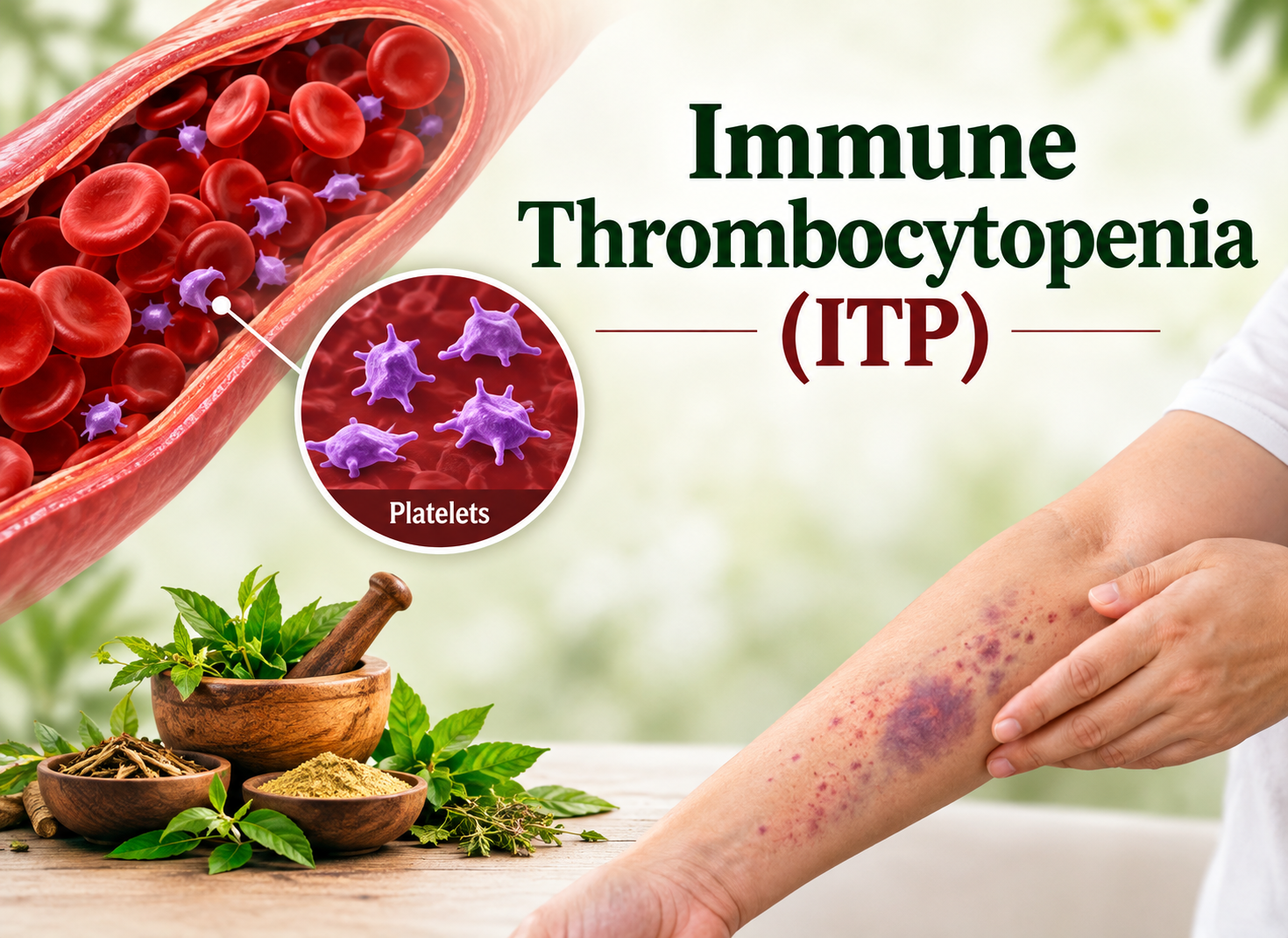
ITP (Immune Thrombocytopenia) is an acquired autoimmune disorder in which the immune system destroys platelets and also interferes with platelet production, resulting in isolated thrombocytopenia and an increased risk of bleeding. It was formerly called Idiopathic Thrombocytopenic Purpura. A low platelet count can cause easy bruising, tiny red/purple spots (petechiae), nose or gum bleeding, or heavy menstrual bleeding. In females, In addition to other bleeding, menstrual bleeding (menorrhagia/heavy periods) can be a major source of blood loss when platelets are very low. Males: Since there is no menstrual blood loss, bleeding may commonly present as epistaxis (nosebleed), gum bleeding, easy bruising, petechiae, blood in urine/stool, etc.
Definition
A low platelet count can cause easy bruising, tiny red/purple spots (petechiae), nose or gum bleeding, or heavy menstrual bleeding. ITP is characterized by:
Isolated platelet count <100 × 10⁹/L (100,000/µL), without another apparent cause of thrombocytopenia. The disease can occur in children or adults and may be acute or persistent/chronic.
S. No |
Condition |
Platelet Count |
1 |
Normal adult |
150,000–450,000/µL (150–450 × 10⁹/L) |
2 |
Mild thrombocytopenia |
100,000–149,000/µL |
3 |
Moderate thrombocytopenia |
50,000–99,000/µL |
4 |
Severe thrombocytopenia |
< 50,000/µL |
5 |
ITP (Immune Thrombocytopenia) |
Typically < 100,000/µL (with otherwise unexplained/isolated thrombocytopenia) |
Causes Of ITP (Immune Thrombocytopenia)
ITP happens when the immune system mistakenly attacks and destroys platelets. The exact reason this immune reaction starts is often unknown. Common associations include:
- After a viral infection — especially in children, ITP may occur after a recent viral illness.
- Autoimmune diseases — such as lupus or rheumatoid arthritis.
- Certain infections — including HIV, hepatitis C, and H. pylori infection.
- Medications — some medicines can trigger immune-mediated low platelets.
- Vaccinations — rarely, ITP can occur after certain vaccines, although this is uncommon.
- Pregnancy — ITP can occur or become apparent during pregnancy.
- Cancer or blood/immune disorders — less commonly, ITP is associated with conditions such as lymphomas.
- No identifiable cause — many cases are called primary ITP, meaning no underlying cause is found.
Symptoms
ITP mainly causes bleeding due to a low platelet count. Some people have no symptoms and are diagnosed through a blood test. Common symptoms
- Petechiae – tiny red or purple pinpoint spots, especially on the legs.
- Purpura/ecchymosis – purple patches or easy bruising.
- Epistaxis – nosebleeding.
- Gum bleeding – bleeding while brushing or spontaneously.
- Prolonged bleeding from small cuts or injuries.
- Blood in urine (hematuria).
- Blood in stool or black, tarry stools.
- Heavy or prolonged bleeding after dental procedures or surgery.
- Fatigue may occur, especially if significant blood loss causes anemia.
- Vomiting blood or coughing blood.
- Heavy MENSTRUAL BLEEDING
- Severe headache, confusion, weakness, or neurological symptoms due to rare intracranial bleeding — this requires emergency medical attention.
- Calf muscle pain
Types Of ITP
ITP (immune thrombocytopenia) is commonly classified according to duration:
- Newly diagnosed ITP – from diagnosis up to 3 months.
- Persistent ITP – lasts more than 3 months but less than 12 months.
- Chronic ITP – lasts more than 12 months.
It can also be classified as:
- Primary ITP – no underlying disease or identifiable cause is found.
- Secondary ITP – occurs in association with another condition, such as certain infections, autoimmune diseases, or medications.
Severity
ITP may also be described according to bleeding severity, rather than platelet count alone:
- No/minimal bleeding
- Mild bleeding (e.g., petechiae, bruising)
- Significant or severe bleeding, which requires urgent medical attention.
Investigation
- CBC:-Hb : Normal or reduced if significant bleeding, WBC: usually normal, Platelets: low, often <100 × 10⁹/L, LFT AND RFT :-TO evaluate hepatic and renal disease .
- Peripheral Blood Smear- Large/young platelets, reflecting increased platelet production by the bone marrow.
- History and physical examination- Look for petechiae, purpura, bruising, epistaxis, gum bleeding, and menorrhagia. Assess for drugs, infections, liver disease, autoimmune disease, and other causes of thrombocytopenia. Splenomegaly is unusual in primary ITP; significant splenomegaly suggests another diagnosis.
- Tests for secondary causes– ITP can occur secondary to infections or autoimmune diseases. Therefore, depending on age and clinical context, investigations may include:
- HIV
- Hepatitis C
- Hepatitis B
- SLE/autoimmune evaluation
- Bone Marrow Biopsy– Megakaryocytes: normal or increase. When is bone marrow examination indicated? It may be considered when the presentation is atypical.
- Anemia or leukopenia that cannot be explained by bleeding
- Abnormal cells on peripheral smear
- Unexplained abnormalities in multiple blood cell lines
- Suspicion of leukemia, myelodysplastic syndrome, aplastic anemia, or marrow infiltration
- Older patient with an atypical presentation
- Failure to respond as expected to treatment.
Treatment Of ITP
Treatment depends mainly on platelet count, severity of bleeding, age, comorbidities.
General Management
- Avoid medicines that increase bleeding risk, particularly aspirin and NSAIDs, unless specifically prescribed.
- Avoid activities with significant risk of trauma when platelet counts are very low.
- Treat the underlying cause if secondary ITP is identified.
- Monitor CBC and platelet count regularly.
- Counsel the patient about warning signs of serious bleeding.
Observation
Patients with no bleeding or only minor bleeding may sometimes be managed with observation rather than immediate medication, particularly when the platelet count is not severely reduced.
First-Line Treatment
Corticosteroids are commonly used when treatment is indicated. Examples include:
- Prednisone/prednisolone
- Dexamethasone
- IVIG (intravenous immunoglobulin) may be used when a rapid increase in platelet count is required, such as significant bleeding or before an urgent procedure.
- Anti-D immunoglobulin may be appropriate in selected Rh-positive, nonsplenectomized patients, but its use is limited.
Emergency Treatment – Severe/Life-Threatening Bleeding
This requires urgent hospital management. Treatment may include:
- IV corticosteroids
- IVIG
- Platelet transfusion in life-threatening bleeding
- Local measures to control bleeding
- Other therapies depending on the bleeding site and clinical situation
Platelet transfusion alone is usually temporary because the immune process can rapidly destroy transfused platelets.
Second-Line Treatment
For patients who do not respond adequately to initial therapy or develop persistent/chronic ITP
- Thrombopoietin-receptor agonists (TPO-RAs) such as eltrombopag or romiplostim
- Rituximab
- Splenectomy in selected patients
Diet
- Protein: dal, beans, paneer/tofu, eggs, fish or lean meat.
- Iron-rich foods: leafy greens, lentils, beans, sesame, pumpkin seeds, and lean meat. Iron is useful if you are actually iron-deficient.
- Folate: spinach and other leafy vegetables, legumes, peas, avocado, citrus fruits.
- Vitamin B12: eggs, dairy, fish/meat, or a supplement if deficient.
- Vitamin C: amla, guava, oranges, lemon, bell peppers—helps iron absorption.
- Whole grains and healthy fats: oats, brown rice, nuts and seeds.
Avoid
- Alcohol: best avoided because it can impair platelet production and increase bleeding risk.
- Herbal supplements/medicines: don’t start them specifically to increase platelets without discussing them with your doctor. Some can affect bleeding or interact with ITP medicines.
- Avoid very high-dose supplements unless a deficiency has been confirmed.
Ayurveda Perspective
Tiryaka Raktapitta is a type of Raktapitta described in Ayurveda. Tiryaka = sideways / lateral direction, Raktapitta = bleeding disorder associated with vitiated Rakta (blood) and Pitta.
In Tiryaka Raktapitta, the bleeding occurs through the sideways/lateral openings of the body, particularly:
- Nose → Epistaxis
- Mouth → Bleeding from gums/oral cavity
- Eyes → Blood-stained discharge
- Ears → Bleeding from ears.
- Skin → Bleeding through skin lesions
In Ayurveda, Immune Thrombocytopenia (ITP) can be discussed in relation to Rakta Dhatu, Raktavaha Srotas and Rakta-Pitta, depending on the clinical presentation. ITP should not be considered identical to a single classical Ayurvedic disease. The Ayurvedic approach involves understanding the individual Dosha, Dushya, Agni, Srotas, Srotodushti and Samprapti before selecting dietary and therapeutic measures.
Viruddha Ahara – Incompatible Diet
Charaka Samhita, Vimana Sthana describes different forms of Viruddha Ahara, which may be considered while evaluating dietary factors:
- Desha Viruddha: Food unsuitable for the geographical region or environment.
- Kala Viruddha: Food unsuitable for the season or time.
- Agni Viruddha: Food inappropriate for the individual’s digestive capacity.
- Matra Viruddha: Improper quantity or proportion of food.
- Satmya Viruddha: Food incompatible with an individual’s habituation or adaptation.
- Dosha Viruddha: Food that aggravates the individual’s Dosha.
- Samskara Viruddha: Incompatibility resulting from improper processing or cooking.
- Virya Viruddha: Combination of foods having incompatible potencies, such as hot and cold potency.
- Koshtha Viruddha: Food unsuitable for the individual’s bowel constitution.
- Avastha Viruddha: Food inappropriate for the person’s current physical condition.
- Krama Viruddha: Incorrect sequence or order of eating.
- Parihara Viruddha: Failure to follow necessary dietary restrictions.
- Upachara Viruddha: Food incompatible with the ongoing therapeutic regimen.
- Paka Viruddha: Improperly cooked or prepared food.
- Samyoga Viruddha: Incompatibility arising from inappropriate food combinations.
- Hridaya Viruddha: Food that is unpleasant or unacceptable to the mind.
- Sampat Viruddha: Food of unsuitable quality, maturity or condition.
- Vidhi Viruddha: Food consumed contrary to the proper rules of eating.
Matraj Bhava
Matraj Bhava is an important Ayurvedic concept concerning factors derived from the mother and their role in the development of the fetus. During pregnancy, maternal factors contribute to fetal development and nourishment. Therefore, maternal diet, lifestyle and overall condition are considered relevant when discussing fetal development from an Ayurvedic perspective.
Pathya–Apathya
Dietary management should be individualized according to Dosha, Agni, Koshtha and clinical condition. In presentations showing Pitta involvement, excessive use of Pitta-vardhaka Ahara may be avoided according to Ayurvedic assessment. Food should preferably be fresh, properly prepared, suitable in quantity and compatible with the individual’s constitution and digestive capacity.
Ayurvedic Assessment in ITP
Assessment may include examination of relevant clinical manifestations:
- Mutra: Urine examination, particularly observing whether blood is present.
- Mala: Stool examination, including assessment for blood.
- Drik/Tvak: Observation of the skin, particularly for petechiae and other visible bleeding manifestations.
- Assessment of Agni, Dosha, Dushya, Srotas, Koshtha and Samprapti to understand the individual presentation.
Srotoshodhana And Deepana–Pachana Drugs
Depending on the Ayurvedic assessment, traditionally used herbs may include:
- Triphala – consisting of Haritaki, Vibhitaki and Amalaki; traditionally used to support bowel regularity, digestion and elimination.
- Guduchi (Tinospora cordifolia) – traditionally used for Ama Pachana and in conditions involving Pitta.
- Haritaki (Terminalia chebula) – traditionally considered Anulomana and used to support bowel clearance.
- Trikatu – traditionally used for Deepana–Pachana, particularly when impaired digestion, Kapha or Ama are involved.
- Punarnava – traditionally associated with fluid balance and Mutravaha Srotas.
- Gokshura (Tribulus terrestris) – traditionally associated particularly with Mutravaha Srotas.
- Mustaka – traditionally used for Deepana–Pachana and digestive disorders.
These herbs should be selected according to the patient’s Agni, Dosha and Samprapti, rather than being used uniformly in every ITP case.
Ayurvedic Substances Traditionally Used In Bleeding Presentations
When bleeding manifestations are present, classical substances traditionally described in Ayurveda include Pravala Pishti, Mukta Pishti, Kamdudha Rasa, Lodhra and Vasa. Vasa (Adhatoda vasica) is traditionally described as having Raktastambhaka, Pittahara and Kaphahara properties. Its leaves and fresh juice (Svarasa) are traditionally used, particularly in Ayurvedic descriptions involving bleeding from the respiratory tract, such as blood-streaked sputum, and in certain other bleeding presentations. Overall, the Ayurvedic approach to ITP focuses on understanding the Dosha-Dushya interaction, Rakta Dhatu, Raktavaha Srotas, Agni and Samprapti, along with appropriate Pathya–Apathya and individualized therapeutic planning. ITP should also be monitored through appropriate hematological investigations and conventional medical care.
Herbal Remedies For ITP By Planet Ayurveda!
Planet Ayurveda is an Ayurvedic wellness brand based in Chandigarh, India, dedicated to bringing traditional Ayurvedic knowledge into modern lifestyles. The brand offers a wide range of herbal formulations prepared from carefully selected herbs and classical Ayurvedic ingredients. Planet Ayurveda focuses on quality, authenticity, purity, and consistent manufacturing practices across its product range. Its formulations cover various areas of everyday wellness and traditional Ayurvedic care. Along with herbal products, Planet Ayurveda provides personalized Ayurvedic consultations with qualified practitioners, offering individualized guidance based on Ayurvedic principles. With customers across India and worldwide, the brand aims to make authentic Ayurveda accessible while maintaining traditional values and modern quality standards. For managing ITP we have following formulations:-
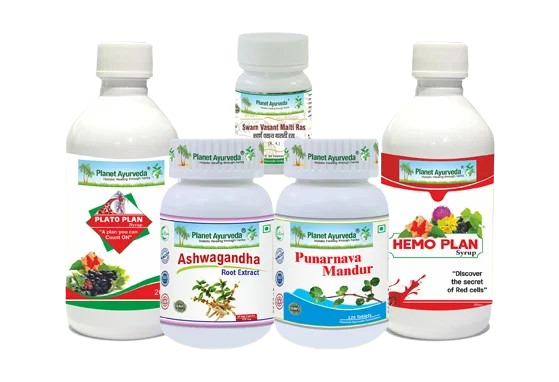
ITP LEVEL-1 (BASIC PACK)

Product Description
1. Plato Plan Syrup
Plato Plan Syrup by Planet Ayurveda combines Carica papaya (Erand Karkati), Tinospora cordifolia (Giloy), Triticum aestivum (Wheat Grass), Withania somnifera (Ashwagandha), Emblica officinalis (Amalaki), Moringa oleifera (Shigru), Leptadenia reticulata (Jeevanti), and Vitis vinifera (Draksha). These ingredients have traditional Ayurvedic relevance to Rasayana, Balya, and Dhatu Poshan, supporting nourishment, strength, and overall vitality. In an individualized Ayurvedic approach, the formulation may be used as supportive nutritional care where Rakta Dhatu and general tissue nourishment are considered important. It is supportive care and should not replace hematological evaluation or prescribed ITP treatment.
Dosage: 5–10 mL (1–2 teaspoons) twice daily after meals.
2. Ashwagandha Capsules
Ashwagandha Capsules contain standardized extract of Withania somnifera, one of Ayurveda’s widely recognized Rasayana herbs. Traditionally, Ashwagandha is described as Balya and Brimhana, supporting strength, nourishment, and physical resilience, with particular relevance to Vata-associated imbalance. Its traditional use may be considered when weakness, reduced vitality, or increased physiological demands accompany an individual’s condition. Modern research has investigated Withania somnifera for antioxidant, adaptogenic, and immunomodulatory activities, although evidence does not establish it as a specific treatment for ITP or a substitute for conventional management. Its inclusion should therefore be individualized according to Prakriti, Agni, Bala, and overall health status.
Dosage: 1 capsule twice daily after meals with plain water.
3. Punarnava Mandur
Punarnava Mandur is a classical Ayurvedic herbo-mineral formulation containing Punarnava (Boerhaavia diffusa), Shunti (Zingiber officinale), Pippali (Piper longum), Maricha (Piper nigrum), Amalaki (Emblica officinalis), Haritaki (Terminalia chebula), Chavya (Piper chaba), Haridra (Curcuma longa), Vidanga (Embelia ribes), Chitraka (Plumbago zeylanica), and Mandura Bhasma. Traditionally, the formulation is associated with Pandu, Agni Deepana, Pachana, and Rakta Dhatu nourishment. Mandura is traditionally used in Ayurvedic approaches involving blood and nutritional status, while the accompanying herbs support digestion and assimilation. It may be considered when weakness or nutritional deficiency is present, but it is not a direct treatment for ITP.
Dosage: 1–2 tablets twice or three times daily after meals with lukewarm water.
4. Hemo Plan Syrup
Hemo Plan Syrup by Planet Ayurveda contains Manjistha (Rubia cordifolia), Shatavari (Asparagus racemosus), Gorakhmundi (Sphaeranthus indicus), Ashwagandha (Withania somnifera), Draksha (Vitis vinifera), and Sariva (Hemidesmus indicus). The formulation brings together herbs traditionally valued for Rakta Dhatu, Pitta balance, nourishment, and Rasayana-oriented care. Manjistha and Sariva are traditionally described in relation to Rakta Prasadana, while Shatavari, Ashwagandha, and Draksha contribute nourishing and restorative qualities within Ayurvedic practice. It may be incorporated into an individualized wellness plan when general blood and tissue nourishment are considered important. It should not be represented as a treatment for immune thrombocytopenia or as a substitute for platelet monitoring and medical care.
Dosage: 5–10 mL twice daily after meals.
5. Swarna Vasant Malti Ras
Swarna Vasant Malti Ras is a classical Ayurvedic herbo-mineral preparation containing Swarna Bhasma, Mukta Bhasma, Shuddha Hingula, Shuddha Parad, Shuddha Gandhak, Kharpara, and Maricha (Piper nigrum). Traditionally, it is regarded as a potent Rasayana and Balya formulation used in Ayurvedic practice for supporting strength, vitality, and tissue nourishment. Swarna and Mukta preparations are traditionally associated with rejuvenative and Pitta-oriented approaches, while Maricha is valued for Agni Deepana and Pachana. In an ITP-focused Ayurvedic regimen, it may be considered only as individualized supportive care rather than a proven platelet-raising therapy. Because it contains processed mineral and metal-derived ingredients, it requires qualified Ayurvedic supervision and appropriate product-quality controls.
Dosage: 1 tablet once daily after meals.
Conclusion
At last, ITP is an acquired autoimmune disorder characterized by immune-mediated destruction of platelets, resulting in thrombocytopenia and an increased risk of bleeding. Early diagnosis, regular monitoring of platelet counts, and appropriate treatment are important to prevent serious bleeding complications. With proper management and follow-up, most patients can achieve good disease control and maintain a normal quality of life.


Dr. Vikram Chauhan
Latest posts by Dr. Vikram Chauhan (see all)
- Urinary Tract Infection (UTI): Causes, Symptoms & Ayurvedic Treatment - November 11, 2026
- Rheumatoid Arthritis: Ayurvedic Treatment, Herbs & RA Care - November 10, 2026
- Ketogenic Diet: Benefits, Foods, Weight Loss & Health Risks - November 6, 2026
- Herbal Remedies For Upadacitinib for IBD – Symptoms, Causes & Treatment in Ayurveda - November 5, 2026
- Autoimmune Disorders: Causes, Symptoms & Ayurvedic Management - November 4, 2026