


Ayurvedic Alternatives to Ibuprofen: Natural Pain Relief
ABSTRACT
Pain, everybody is familiar with this word, so what exactly is pain? Pain is a signal from the body indicating tissue damage, inflammation or stress. It can be acute (short acting) or chronic (persistent). Everyone in today’s life opts for over-the- counter painkillers to relieve pain. What if I say there are better safe and effective herbal drugs and remedies for pain that have zero side effects! Yes, in Ayurveda there are many natural, 100% safe herbals that not only provide relief from pain but also treat its root cause. So let’s discuss a very common medicine Ibuprofen that is widely used as a painkiller and its ayurvedic alternatives.

INTRODUCTION
Ibuprofen was discovered by Dr. Stewart Adams and John Nicholson during the search for an alternative of corticosteroids in rheumatoid arthritis. It is a propionic acid derivative under NSAIDS (Non Steroidal Anti Inflammatory Drugs). It is commonly used to relieve pain, reduce fever, and control inflammation. The medicine may be administered orally or through intravenous injection and it usually starts showing its effect within about one hour. It is absorbed rapidly and completely after oral administration however food intake can decrease its absorption by 20-30%.
MODE OF ACTION
- Ibuprofen acts as a non-selective inhibitor of the enzyme cyclooxygenase (COX) which facilitates the conversion of arachidonic acid into prostaglandin H2 (PGH2).
- Prostaglandins derived from PGH2 are major mediators of pain perception and inflammatory responses.
- Ibuprofen reduces the amount of prostaglandins produced at the site of inflammation and throughout the body. With fewer prostaglandins present, nerve endings are less sensitive, and the sensation of pain, along with associated inflammation (redness and swelling) and fever decreases.
INDICATIONS
- Headache and Migraine
- Dysmenorrhea
- Toothache
- Rheumatoid Arthritis, Osteoarthritis and other musculoskeletal conditions
- It is effective in soft tissue injury, fractures, tooth extraction, postpartum and postoperatively
CONTRAINDICATIONS
- Hypersensitivity
- Peptic ulcer disease
- Severe heart failure
- Severe liver disease
- Severe renal impairment
ADVERSE EFFECTS
- Gastrointestinal bleeding (esp. if alcohol is consumed)
- Gastric discomfort
- Nausea and vomiting
- Dizziness and Blurring of vision
- Tinnitus
- Depression
- Rarely gastric erosion and occult blood loss occur
Now since there are so many side effects of its use why not switch to a better alternative that is equally effective and is safer. There are various herbal drugs used for this purpose. Let’s take a look at them one by one:
1. Shallaki (Boswellia serrata)
- It is a prominent ayurvedic herb renowned for its potent anti-inflammatory and analgesic properties. Its resin is used as it contains monoterpenes, diterpenes, triterpenes that are responsible for its action.
- Its warm lepa (paste) is applied in sandhivata (Osteoarthritis) as it has vedanahara (pain reducing) properties.
2. Curcumin (Curcuma longa)
- Also known as turmeric, it is a very useful herb found commonly in our kitchen. It is hot in potency so it suppresses kapha and vata and has Tikta Rasa (bitter taste) that pacifies Pitta dosha.
- Its active constituent Curcumin and other curcuminoids reduces pain and has anti-inflammatory actions.
- Its paste is specially used to reduce inflammation and pain.
3. Rasana (Pluchea lanceolata)
- Rasana is one of the best drugs to pacify Vata Dosha and is an excellent Vedanasthapaka (Pain Reliever).
- Its active alkaloids like triterpenes, moretenol acetate, moretenol and neolupenol exhibit anti-inflammatory activity.
- Its paste or massage with medicated oil is used in pain and inflammatory conditions. Its decoction is also widely used.
4. Guggulu (Commiphora mukul)
- Guggulu is especially indicated in conditions like Sandhivata (Osteoarthritis), Aamvata (Rheumatoid arthritis), Grudhrasi (Sciatica), Nadishoola (Nervine pain) and other Vata disorders due to its Vata-pacifying and Shothahara (anti-inflammatory) effects.
- Guggulsterones, volatile oils, α- and β-guggulic acids, etc. Contribute to anti-inflammatory and analgesic effects by modulating leukotriene and prostaglandin pathways.
5. Nirgundi (Vitex negundo)
- It is hot in potency and pacifies vata and kapha thus providing significant relief from pain and inflammation. The essential oils act on both central and peripheral nervous systems, thus reducing pain perception.
- The decoction of nirgundi leaves is given in Sciatica and its medicated oils are very beneficial in musculoskeletal pains.
6. Eranda (Ricinus communis)
- It is used in Kapha Vata disorders and is especially recommended in Aamvata (Rheumatoid arthritis).
- The Ayurvedic Pharmacopoeia of India recommends its use as decoction in rheumatism, lumbago, and inflammatory conditions.
- Its leaves are warmed and tied on the affected area or massage with eranda oil is recommended in pain afflicted areas.
7. Padmak (Prunus cerasoides)
- Padmak is used as an analgesic due to its active constituents like prunetin, padmakastein, sacchuranin, taxifolin.
- It has Laghu (Light), Snigdha (unctuousness) Guna (properties); sheet virya (cold potency) and has specific action Vedanasthapana (Pain Reliever).
Some of the classical formulations that include these drugs are:
- Rasnadi Kwath
- Yograj Guggul
- Kaishore Guggul
- Erandasaptak Kwatha
- Nirgundi Tail
- Rasnasaptak Kwatha
PLANET AYURVEDA’S BOSWELLIA CURCUMIN
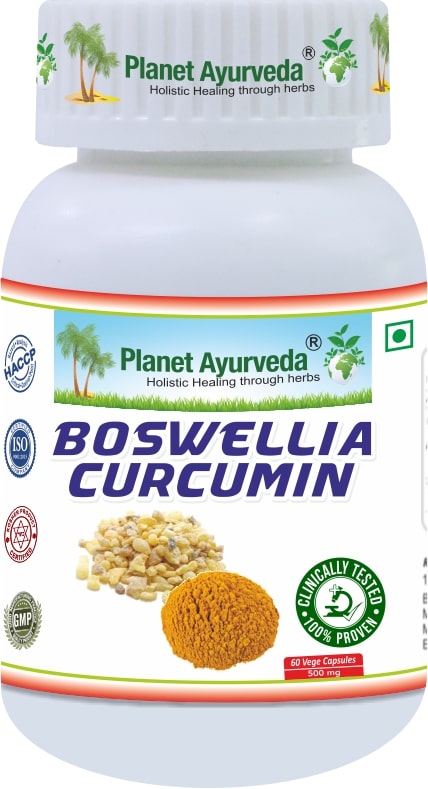
As discussed above Boswellia and Curcuma both have excellent results in the management of pain and when combined together they show marvelous results in pain. And such a combination is available as Planet Ayurveda’s Boswellia Curcumin. It is a capsule formulation made of pure and organic extracts of boswellia and curcumin. It is made under supervision of expert MD doctors and is free from any preservatives, chemicals, colour and additives. The presence of active alkaloids like boswellic acids, terpenoids and curcuminoids regulates the cyclooxygenase-2 (COX-2) pathway thus reducing the production of prostaglandins associated with inflammation and that provides relief to the pain. It helps to pacify Vata and Kapha Dosha and has Shothahara (anti-inflammatory) properties. Thus it is excellent preparation for pain management and has wonderful results.
Dosage: 1 capsule twice in a day with plain water, after meals.
BOSWELLIA CURCUMIN

CONCLUSION
Thus pain being a very common issue in this modern world and everyone wants to get quick relief. While Ibuprofen provides symptomatic relief from pain and its prolonged use is associated with gastric irritation, ulcers, kidney damage, and cardiovascular risks as it disrupts the body’s natural protective prostaglandins, the Ayurveda will aim at the root cause and correct the internal disharmony by improving Jathara Agni (Digestive Fire), Srotoshodhana (Detoxifying channels), Dhatu Poshana (Rejuvenating body tissues) and thus provide long-term management of chronic inflammatory conditions like osteoarthritis, offering a safer profile for prolonged use that is free from any side effects.


Dr. Vikram Chauhan
Latest posts by Dr. Vikram Chauhan (see all)
- Anti-CCP Test – Normal Range, Positive Results, and Role in Rheumatoid Arthritis Diagnosis - February 24, 2026
- Archana Puran Singh Diagnosed with CRPS – Chronic Pain Condition Awareness, its Impact, Symptoms, Causes & Ayurveda View - January 29, 2026
- Vikramprash & Shilajit Resin for Winter Energy, Immunity and Vitality - December 26, 2025
- Winter Health Tips for Kids: Ayurvedic Diet, Immunity & Lifestyle Care - December 16, 2025
- Ayurvedic Alternative of Sertraline (Zoloft) for Stress, Anxiety & Depression - December 15, 2025