


Hypertension: Understanding High Blood Pressure Through an Ayurvedic Lens
Abstract
It is very common these days to encounter individuals with elevated blood pressure, making hypertension one of the most prevalent cardiovascular conditions worldwide. Often called the silent killer, hypertension may remain asymptomatic for years while gradually damaging vital organs such as the heart, kidneys, and brain. Modern lifestyles including high salt intake, sedentary behavior, stress and obesity contribute significantly to its rising incidence. Early detection and proper management are crucial to prevent complications like stroke, heart attack, and chronic kidney disease. In addition to conventional approaches, Ayurvedic medicine offers preventive and therapeutic strategies aimed at balancing the underlying doshas, strengthening the heart (Hridaya) and maintaining vascular health. So, let’s learn about various anti-hypertensives and their potential alternatives.

What Is Hypertension & How Does It Affect Blood Pressure Level?
Hypertension is a condition in which blood pressure is persistently elevated to 130/90 mm of Hg or above, thus significantly increasing the risk of cardiovascular disease, stroke and kidney failure and antihypertensives are the group of medications designed to control this elevated pressure and protect vital organs from long-term damage. They work through various mechanisms like relaxing blood vessels, reducing heart rate and cardiac workload, removing excess fluid and salt or blocking hormonal pathways responsible for vasoconstriction and sodium retention. Some of the commonly used anti-hypertensives are:-
Losartan
It helps in lowering blood pressure, reducing cardiovascular strain and protecting kidney function especially in patients with diabetes. It is an angiotensin II receptor blocker (ARB) that works by blocking the action of angiotensin II, a hormone that causes blood vessels to constrict and raises blood pressure. It is available in the market under brand names Cozaar, Hyzaar, Lozap, etc.
Amlodipine
Amlodipine is a commonly prescribed calcium channel blocker used to treat high blood pressure and is known for its long-acting effect. It works by inhibiting the influx of calcium ions into vascular smooth muscle and cardiac cells, leading to relaxation of blood vessels and improved blood flow. It is available in the market under brand names Norvasc, Amlovas,etc.
Metaprolol
Metoprolol is a commonly used beta-blocker that helps manage high blood pressure. By blocking beta-1 adrenergic receptors in the heart, it reduces heart rate, cardiac output and oxygen demand which helps in controlling blood pressure and cardiac workload. It is available in the market under the brand name Lopressor, Betaloc, Metolar, Toprol, etc.
Ayurvedic Approach to Managing Hypertension Naturally
In ayurveda, hypertension can be correlated with imbalance of Vata Dosha in the blood vessels. The vitiated Vata Dosha along with Pitta and Kapha Dosha further vitiates the rakta dhatu (blood tissue) leading to symptoms like Sirashoola (headache), Daurbalya (weakness), Hrid-Kampa (palpitations), and Daha (burning sensation). Treatment mainly focuses on correcting Dosha imbalance, improving Raktavaha Srotas function and strengthening Hridya Dhatu. Some of the herbs used in hypertension are:-
1. Sarpagandha
- Sarpagandha or Rauwolfia serpentine is one of the best and highly recommended herbs in hypertension and it also does not cause hypotension or postural hypotension.
- Its main alkaloid is Reserpine which is hypotensive. It acts on the vasomotor centre which causes generalised vasodilation and thus lowering the blood pressure.
- Its root powder is used in doses of 1-2 grams.
2. Arjuna
- Arjuna or Terminalia arjuna is one of the best herbs to regulate cardiac ailments.
- It has Rakta Prasadana (blood purifying) properties which controls vitiation of Rakta (blood) Dhatu (tissue) thus preventing Pitta related hypertension.
- It provides antioxidant and tissue-rejuvenating effects thus reducing arterial stiffness and oxidative stress.
3. Rudraksha
- The Ayurvedic Pharmacopoeia of India indicated the use of seeds of Rudraksh or Elaeocarpus ganitrus in hypertension.
- The aqueous extract of its seed powder exhibits anti-hypertnsive actions by its action on renin angiotensin system.
- As per ancient texts, wearing the necklace of rudraksh shows positive effects on the body as its electromagnetic properties are believed to disperse negative energy and controls the flow of bio-electric current in the body.
4. Garlic
- Garlic or Allium sativum is widely used in hypertension as it is known to have hrudya (cardioprotective) properties and Vata Dosha pacifying properties.
- It significantly lowers the blood pressure, especially the systolic part. Its alkaloid, Allicin is a sulphur containing compound known to act on the body’s nitric oxide system which relaxes the arteries and lowers blood pressure.
5. Gokshur
- Gokshur or Tribulus terrestris is Mutral (Diuretic) and has vata dosha pacing properties thus it reduces the intra vascular volume and prevents the excess accumulation of fluid in the body.
- It has strong anti-oxidant properties and this helps in strengthening the cardiac muscles and the blood vessels.
6. Praval pishti
- Praval or Corallium rubrum is known for its Rasayana (rejuvenating), Hridya (cardio-protective) and Shleshma-Pitta balancing properties.
- It is believed to restore mineral balance, especially calcium and other electrolytes, which can support vascular tone and blood pressure stability.
7. Pushkarmoola
- Pushkarmool or Inula racemosa has active constituents like alantolactone, isoalantolactone, inulin, etc. exhibit vasodilatory action, anti-inflammatory and mild diuretic action.
- It has ruksha (dry) and tikshana (sharp) nature and regulates the kapha and meda metabolism thus reduces the vascular stiffness, which is a major cause of reduced vascular elasticity and high blood pressure.
Planet Ayurveda Herbal Alternatives for Hypertension Support
Herbal Alternatives for Hypertension Support
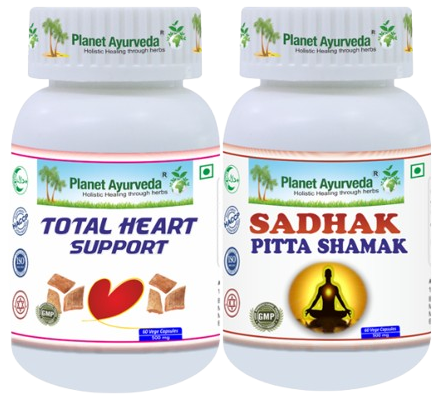

1. Total Heart Support
It is a capsule formulation of Planet Ayurveda consisting of Arjuna (Terminalia arjuna), Ashwagandha (Withania somnifera), Brahmi (Bacopa monnieri) and Shankhpushpi (Convolvulus pluricaulis). It contains potent alkaloids like Somniferine, Anaferine, Withanine, Isopelletierine, Brahmine and Arjunetin which collectively calm Vyana Vata (a type of Vata Dosha), reduce sympathetic overactivity, promote vasodilation and stabilize Hridaya (Heart) function. It significantly improves the Ejection Fraction of the heart.
Dosage: 1-2 capsules twice daily with plain water after meals.
2. Sadhak Pitta Shamak
This is a capsule formulation of Planet Ayurveda which consists of Sarpagandha (Rauwolfia serpentine), Ashwagandha (Withania somnifera), Prawal (Coral), Mukta pishti (Pearl) and many others. It especially balances the Sadhak Pitta which is a type of Pitta Dosha and is primarily located in the heart thus specifying the formulation’s name. It contains bioactive constituents such as Reserpine, withanolides, etc. that collectively help regulate hypertension.
Dosage: 1-2 capsules twice daily with plain water after meals.
Conclusion
Hypertension is a chronic medical condition where the force of blood against the artery walls is consistently elevated. Persistent hypertension increases the risk of stroke, heart attack, kidney damage and other complications. Modern management focuses on lifestyle modification and medications such as ACE inhibitors, ARBs, beta-blockers, calcium channel blockers and diuretics. While effective in controlling blood pressure, these treatments often address only symptoms and may cause side effects and can require lifelong dependence. In Ayurveda, hypertension is understood as a manifestation of Vata-Pitta imbalance and Rakta Dhatu vitiation. Ayurvedic management emphasizes herbs like Sarpagandha (Rauwolfia serpentina), Arjuna (Terminalia arjuna), Pushkarmool (Inula racemosa), etc. along with diet, stress reduction, yoga and detoxification therapies to restore Dosha balance and purify the blood. Unlike allopathy, Ayurveda treats the root cause, improves overall cardiovascular health and provides long-term, side-effect-free management, making it a preferable holistic approach for hypertension.


Dr. Vikram Chauhan
Latest posts by Dr. Vikram Chauhan (see all)
- Dravet Syndrome: Symptoms, Causes, Diagnosis & Treatment - September 7, 2026
- Erythema Dyschromicum Perstans: Causes, Symptoms & Treatment - September 5, 2026
- Dental Diseases and Their Influence on Kidney Health – Oral Health & Kidney Disease Connection - July 8, 2026
- Anti-CCP Test – Normal Range, Positive Results, and Role in Rheumatoid Arthritis Diagnosis - February 24, 2026
- Archana Puran Singh Diagnosed with CRPS – Chronic Pain Condition Awareness, its Impact, Symptoms, Causes & Ayurveda View - January 29, 2026